My Heart is Laden
21 hours ago
Perhaps the hand in dreaming
of being a star sower
made forgotten music echo
Tal vez la mano, en sueño,
del sembrador de estrellas,
hizo sonar la música olvidada
como una nota de la lira inmensa,
y la ola humillde a nuestros labios vino
de unas pocas palabras verdaderas.

I have often tried to determine in what that beauty consisted, and how it would be possible for me to describe it if I wished to disclose the secret to another mind. "What!" someone will say, "do you mean that external objects, without color or shape, in disorder and unlighted, can take on an aspect that appeals to the eyes and the mind?" None but a painter could ever say to me: "Yes, I understand." He would recall Rembrandt's Philosopher in His Study: that enormous room, three-fourths in darkness, those endless stairways which wind no one knows how; those vague lights (which blaze up and go out, you know not why, in different parts) of the picture; that whole scene, indefinite yet clear; that powerful coloring, which after all is only light brown and dark brown; that magical use of chiaroscuro, that play of light and shadow on the most trivial objects, a chair, a jug, a copper urn; and lo! those objects which do not deserve to be glanced at, much less to be painted, become so interesting, so beautiful after their manner, that you cannot take your eyes from them. They have received the breath of life, they exist.
-- George Sand Consuelo
Translated by George Burnham Ives
Rembrandt's Philosopher in His Study
As I listened from a beach-chair in the shade
To all the noises that my garden made,
It seemed to me only proper that words
Should be withheld from vegetables and birds.
A robin with no Christian name ran through
The Robin-Anthem which was all it knew,
And rustling flowers for some third party waited
To say which pairs, if any, should get mated.
Not one of them was capable of lying,
There was not one which knew that it was dying
Or could have with a rhythm or a rhyme
Assumed responsibility for time.
Let them leave language to their lonely betters
Who count some days and long for certain letters;
We, too, make noises when we laugh or weep:
Words are for those with promises to keep.
-- W.H. Auden
I conceived of the garden as a poem in stanzas. Each terrace contributes to the garden as a whole in the same way each stanza in a poem has a life of its own, and yet is part of a progressive whole as well.
The form provides some degree of repose, letting our mind rest in the comparatively manageable unit of the stanza, or terrace. Yet there is also a need to move on, to look beyond the stanza, into the poem as a whole.
Often, when you finish reading a poem, the impulse is to revisit the beginning now that you've been all the way through it, and then each subsequent trip through the poem is different and colored by having seen the whole thing.
Once you have perceived the garden as a whole, the individual tiers of the garden take on a different form because you have seen them both as a part and as a whole. One of the mysteries of gardening is that the garden reflects the viewer's own state of being at the time, just as your response to a poem lets you know something about your preoccupations or your susceptibility as you read it.
-- Stanley Kunitz The Wild Braid
[The style of old age] is not always a product of the years; it is a gift implanted along with his other gifts in the artist, ripening, it may be, with time, often blossoming before its season . . . : it is the reaching of a new level of expression, such as the old Titian's discovery of the all-penetrating light which dissolves the human flesh and the human soul to a higher unity; or such as the finding by Rembrandt and Goya, both at the height of their manhood, of the metaphysical surface which underlies the visible in man and thing, and which nevertheless can be painted; or such as The Art of Fugue which Bach in his old age dictated without having a concrete instrument in mind, because what he had to express was either beneath or beyond the audible surface of music.
-- Hermann Broch, in the introduction to On the Iliad by Rachel Bespaloff
Translated by Mary McCarthy
While I was sitting one night with a poet friend watching a great opera performed in a tent under arc lights, the poet took my arm and pointed silently. Far up, blundering out of the night, a huge Cecropia moth swept past from light to light over the posturings of the actors. "He doesn't know," my friend whispered excitedly. "He's passing through an alien universe brightly lit but invisible to him. He's in another play; he doesn't see us. He doesn't know. Maybe it's happening right now to us."
-- Loren Eiseley The Invisible Pyramid
Loren Eiseley
The beautiful appearance of the dream-worlds, in creating which every man is a perfect artist, is the prerequisite of all plastic art, and in fact, as we shall see, of an important part of poetry also. In our dreams we delight in the immediate apprehension of form; all forms speak to us; none are unimportant, none are superfluous. But, when this dream-reality is most intense, we also have, glimmering through it, the sensation of its appearance . . . And it is not only the agreeable and friendly pictures that he experiences in himself with such perfect understanding: but the serious, the troubled, the sad, the gloomy, the sudden restraints, the tricks of fate, the uneasy presentiments, in short, the whole Divine Comedy of life, and the Inferno, also pass before him, not like mere shadows on the wall—for in these scenes he lives and suffers—and yet not without that fleeting sensation of appearance. And perhaps many will, like myself, recall that amid the dangers and terrors of dream-life they would at times, cry out in self-encouragement, and not without success: "It is only a dream! I will dream on!"
-- Friedrich Wilhelm Nietzsche The Birth of Tragedy
Translated by Clifton P. Fadiman
about The Birth of Tragedy
We two, how long we were fool'd,
Now transmuted, we swiftly escape as Nature escapes,
We are Nature, long have we been absent, but now we return,
We become plants, trunks, foliage, roots, bark,
We are bedded in the ground, we are rocks,
We are oaks, we grow in the openings side by side,
We browse, we are two among the wild herds spontaneous as any,
We are two fishes swimming in the sea together,
We are what locust blossoms are, we drop scent around lanes mornings and evenings,
We are also the coarse smut of beasts, vegetables, minerals,
We are two predatory hawks, we soar above and look down,
We are two resplendent suns, we it is who balance ourselves orbic and stellar, we are as two comets,
We prowl fang'd and four-footed in the woods, we spring on prey,
We are two clouds forenoons and afternoons driving overhead,
We are seas mingling, we are two of those cheerful waves rolling over each other and interwetting each other,
We are what the atmosphere is, transparent, receptive, pervious, impervious,
We are snow, rain, cold, darkness, we are each product and influence of the globe,
We have circled and circled till we have arrived home again, we two,
We have voided all but freedom and all but our own joy.
-- Walt Whitman (b. 31 May 1819), from Leaves of Grass
The Walt Whitman Archive
Did the people he photographed in the Dominican Republic know who he was?
"Sometimes someone would come up to me and say, 'You're the guy from Sex and the City.' "
Did he ever join in doing the merengue during a photo shoot?
"A couple of times. I can do a little merengue, It's graceful, but it's difficult to dance. To dance it, you have to seriously study the movements. I try to get a partner who knows what she's doing, and I try to follow."
How about the tango?
"I can't dance the tango to save my life," he says.
-- Mikhail Baryshnikov, interviewed by Milton Esterow in 'A Little Dance with a Digital Camera' ARTnews May 2007
ARTnews
Mikhail Baryshnikov: Dominican Moves
For fragrance is indeed what the past well knew it to be, a refreshment and a strength, a sweet and human pleasure, an exorciser of demons from the body and the besieged and troubled spirit. Subtlest of influences, touching the emotion directly, asking nothing from the mind, it not only wakes in us an emotion of place, but summons up as well a poignant emotion of ourselves as we were in time and the place remembered. The odor of a ploughed field in the spring is like a hand laid upon the heart, having in it all the beauty, the poignancy, and the tenderness of earthly living, all the poetry of the melancholy and ecstasy of spring, of the branch, the new leaf and the warm wind, and the sinking of some last great and solitary winter star.
-- Henry Beston Herbs and the Earth
She stood before the mirror in her white slip. As she curved her arm over her head in washing, she remembered how she had sat on the fire escape when a little girl and watched the big girls in the flats across the yards getting ready for their dates. Was some one watching her as she had once watched?
She looked towards the window. Yes, across two yards she saw a little girl sitting on a fire escape with a book in her lap and a bag of candy at hand. The girl was peering through the bars at Francie. Francie knew the girl, too. She was a slender little thing of ten, and her name was Florry Wendy.
Francie brushed out her long hair, braided it and wound the braids around her head. She put on fresh stockings and white high-heeled pumps. Before she slipped a fresh pink linen dress over her head, she sprinkled violet sachet powder on a square of cotton and tucked it inside her brassiere . . .
She looked across the yards and saw that Florry was still staring at her through the bars of the fire escape. Francie waved and called:
"Hello, Francie."
"My name ain't Francie," the little girl yelled back. "It's Florry, and you know it, too."
"I know," said Francie.
She looked down into the yard. The tree whose leaf umbrellas had curled around, under and over her fire escape had been cut down because the housewives complained that wash on the lines got entangled in its branches. The landlord had sent two men and they had chopped it down.
But the tree hadn't died . . . it hadn't died.
A new tree had grown from the stump and its trunk had grown along the ground until it reached a place where there were no wash lines above it. Then it had started to grow towards the sky again.
Annie, the fir tree, that the Nolans had cherished with waterings and manurings, had long since sickened and died. But this tree in the yard—this tree that men chopped down . . . this tree that they built a bonfire around, trying to burn up its stump—this tree lived!
It lived! And nothing could destroy it.
Once more she looked at Florry Wendy reading on the fire escape.
"Goodbye, Francie." she whispered.
She closed the window.
-- Betty Smith A Tree Grows in Brooklyn
What I am saying will be taken as a mad paradox, at which one can only be amazed, and yet I cannot help saying what I think—namely, that people of our circle, of whom some write verses, stories, novels, operas, symphonies, sonatas, paint various sorts of pictures, make sculptures, while others listen to them and look at them, and still others evaluate and criticize it all, argue, denounce, triumph, erect monuments to each other, and have done so over the course of several generations, that all these people, artists, public, and critics, with very few exceptions, have never, save in early childhood and youth, before they heard any reasoning about art, experienced that simple feeling, familiar to the simplest man and even to a child, of being infected by the feelings of another, which makes us rejoice over another's joy, grieve over another's grief, merge our souls with another's, and which constitutes the essence of art, and that therefore these people not only cannot distinguish true art from its counterfeits, but always mistake the worst and most false for genuine art, without noticing the genuine, because counterfeits are always more flashy, while true art is modest . . . The effect of the true work of art is to abolish in the consciousness of the perceiver the distinction between himself and the artist, and not only between himself and the artist, but also between himself and all who perceive the same work of art. It is this liberation of the person from his isolation from others, from his loneliness, this merging of the person with others, that constitutes the chief attractive force and property of art.
-- Leo Tolstoy What is Art?
Translated by Richard Pevear and Larissa Volokhonsky
Of these same three things the planets and all the stars consist; and not only the stars but all bodies that grow and are born from them ... The inner stars of man are, in their properties, kind, and nature, by their course and position, like his outer stars, and different only in form and material. For as regards their nature, it is the same in the ether and in the microcosm.
-- Paracelsus Paracelsus: Selected Writings, ed. Jolande Jacobi
Translated by Norbert Guterman
Paracelsus
The study of electricity to-day comprehends a vast range of phenomena, in all of which we are brought back ultimately to the fundamental conceptions of electric charge and of electric and magnetic fields. These conceptions are at present ultimates, not explained in terms of others. In the past there have been various attempts to explain them in terms of electric fluids and aethers having the properties of material bodies known to us by the study of mechanics. To-day, however, we find that the phenomena of electricity cannot be so explained, and the tendency is to explain all other phenomena in terms of electricity, taken as a fundamental thing. The question, "What is electricity?" is therefore essentially unanswerable, if by it is sought an explanation of the nature of electricity in terms of material bodies.
-- Professor Harold A. Wilson, writing on "Electricity" Encyclopaedia Britannica (1947)
This is reminiscent of Lao-tzu beginning, "The Tao which can be explained is not the eternal Tao," and then going on to write a whole book about it; for the article which follows this paragraph is a vastly learned discussion of the properties and behavior of this unknown "ultimate."
-- Alan Watts Tao: The Watercourse Way (in which Wilson's passage is quoted)
[I]n so far as my hand knows hardness and softness, and my gaze knows the moon's light, it is as a certain way of linking up with the phenomenon and communicating with it. Hardness and softness, roughness and smoothness, moonlight and sunlight, present themselves in our recollection not pre-eminently as sensory contents but as certain kinds of symbioses, certain ways the outside has of invading us and certain ways we have of meeting this invasion . . .
-- Maurice Merleau-Ponty Phenomenology of Perception
Translated by Colin Smith
We give in to the persuasions of the river, floating
Swiftly downstream as well as the leaves beside us,
Ahead of us, with little choice
Which way it may be next
That we find ourselves
One boat-length farther along, taking the rough with the smooth,
To the slackness of pools, down long, eddying riffles,
To the rush of spillways narrowing
And steepening suddenly
To white water
Where the river is leaving everything to chance and turning
Over and interrupting its own half-motions
Constantly in bursts and arches,
Mantling, spun into tendrils,
Its wild gestures
As memorable at a glance as marble but dying, reborn
Only another glance away, as the center
Of our attention, shifting at random
Everywhere like the sunlight,
As caught by the play
Of light on all these surfaces, churnings and interweavings,
Upheavals, blossomings, an impulsive garden
Where we search and search as if for answers
And see its one reply:
Nothing is the same
Ever. This intricate bewilderment of currents,
In its least ripple, is unrepeatable.
The windbreak of alders we pass now,
The gravely leaning pale-boned
Row gone ashen,
Love, is another river, its bed channeled by seasons.
Our faces come near each other, mysterious
As water always. We cross a pool,
Translucent, the stones below us
Glimmering, remaining.
-- David Wagoner
David Wagoner
There is a quality to reality when I am exhausted: it no longer seems "photographed" but "painted"—and therefore much more intended.
-- Rodger Kamenetz Terra Infirma
Rodger Kamenetz
For there are two silences: a silence can be no more than the absence of noise, it can be inert, or at the other end of the scale, there is a nothingness that is infinitely alive, and every cell in the body can be penetrated and vivified by this second silence's activity. The body then knows the difference between two relaxations—the soft floppiness of a body weary of stress telling itself to relax, and the relaxation of an alert body when tensions have been swept away by the intensity of being. The two silences, enclosed within an even greater silence, are poles apart.
-- Peter Brook Threads of Time
After I can no longer see her
she says to me For a while there is all
that asking about how the body becomes
itself as it goes and what it is becoming
what is happening to it where it is going
step by step one moment at a time
and then all that falls aside like a curtain
and the body is gone with its worn questions
hollow joints marrow and breath and instead there is
the way whatever lived in it goes on as itself
neither before nor after neither moving nor still
and while the body was going somewhere
the way was there to begin with in the feet themselves
wherever they went and you know the sound
-- W.S. Merwin
Midway along our road of life I woke
to find myself in a secret dark wood,
for I had lost the narrow path. To evoke
what it was like—how hard, I barely could.
This wood was savage, dense and strange! The thought
of it renews those fears that I withstood,
a place so bitter, only to be caught
in death is worse. Yet there I found my share
of good, so now I'll tell what else it brought.
I cannot rightly say how I came there,
I was so drugged with sleep the moment when
I lost the true way, wandering unaware,
Yet when . . . I looked up, saw the hill's wings with their clean
early light cast from the planet whose sight
leads men straightly on every road. The scene
diminished and I felt the force of fright
lessen in the lake of my heart, that fear
I felt so piteously throughout the night.
-- Dante Alighieri The Divine Comedy
Translated by Charles S. Singleton
And so, looking into the pure curve
is it that we would compel straightness into it?
At the end of the road there are things we can say to each other
of truth, mystery, immeasurable magnitude.
+
In the immeasurable magnitude of what has been given us
sometimes it is to understand existence as a pure point
where ten-thousand laser beams meet. There our distances are vaporized.
Now I look at you in an entire recognition. Creation has become a lens.
-- Peyton Houston, from XVI Complex Songs at the Borders of Silence
Lay your sleeping head, my love,
Human on my faithless arm;
Time and fevers burn away
Individual beauty from
Thoughtful children, and the grave
Proves the child ephemeral:
But in my arms till break of day
Let the living creature lie,
Mortal, guilty, but to me
The entirely beautiful.
Soul and body have no bounds:
To lovers as they lie upon
Her tolerant enchanted slope
In their ordinary swoon,
Grave the vision Venus sends
Of supernatural sympathy,
Universal love and hope;
While an abstract insight wakes
Among the glaciers and the rocks
The hermit's carnal ecstasy.
Certainty, fidelity
On the stroke of midnight pass
Like vibrations of a bell
And fashionable madmen raise
Their pedantic boring cry:
Every farthing of the cost,
All the dreaded cards foretell,
Shall be paid, but from this night
Not a whisper, not a thought,
Not a kiss nor look be lost.
Beauty, midnight, vision dies:
Let the winds of dawn that blow
Softly round your dreaming head
Such a day of welcome show
Eye and knocking heart may bless,
Find our mortal world enough;
Noons of dryness find you fed
By the involuntary powers,
Nights of insult let you pass
Watched by every human love.
-- W.H. Auden
for Yen and Jesse
Below the surface-stream, shallow and light,
Of what we say we feel—below the stream,
As light, of what we think we feel—there flows
With noiseless current strong, obscure and deep,
The central stream of what we feel indeed.
-- Matthew Arnold
You know that in your soul there are certain areas—memories, pain, secrets—that are private, that you would only share with the person you love and trust the most. You do not open your heart and show it to just anyone . . .
Desire is not love. Love is something much more responsible. It has care in it.
-- Thich Nhat Hanh Teachings on Love
The work of art proper is something not seen or heard, but something imagined.
-- R.G. Collingwood The Principles of Art
Coming into the high room again after years
after oceans and shadows of hills and the sounds of lies
after losses and feet on stairs
after looking and mistake and forgetting
turning there thinking to find
no one except those I knew
finally I saw you
sitting in white
already waiting
you of whom I had heard
with my own ears since the beginning
for whom more than once
I had opened the door
believing you were not far
-- W.S. Merwin
To be too much in the fashion is as vulgar as to be too far behind it. No really well-bred man follows every new cut that he sees in his tailor's fashion-book. Only very young men and those not of the most aristocratic circles, are guilty of this folly.
In the morning wear frock-coats, double-breasted waistcoats, and trousers of light or dark colours, according to the season.
In the evening, though only in the bosom of your own family, wear only black, and be as scrupulous to put on a dress-coat as if you expected visitors. If you have sons, bring them up to do the same.
For evening At Homes, dinner-parties, and balls, wear a black dress-coat, black trousers, black or white waistcoat, white cravat, white kid gloves, and thin patent-leather boots. A black cravat may be worn in full dress, but it is not so correct as a white one.
A tail-coat should be worn on all but informal occasions. A dinner-jacket may be worn for home or informal dinners, or when going to the theatre with men only . . .
For daytime, in the park lounge suits, with bowlers, straw or Homburg hats, are worn in the morning, but after lunch a frock-coat or morning coat and silk hat must take their place. With a black frock-coat dark trousers should be worn. Brown boots must, of course, never be worn with a frock-coat . . .
In town, gloves should be worn out of doors. A stick may be carried, but not when going to church.
-- Etiquette for Gentlemen: Rules for Perfect Conduct (1890)
All that's lost is somewhere.
--Mary Poppins, in Mary Poppins in Cherry Tree Lane, by P.L. Travers
Sometimes something wants to be said, sometimes a way of saying wants to be used.
-- Paul Valéry "Poésie et Pensée Abstraite" from Modern French Poets on Poetry ed. Robert Gibson
Man is a thinking reed but his great works are done when he is not calculating and thinking. "Childlikeness" has to be restored with long years of training in the art of self-forgetfulness. When this is attained, man thinks yet he does not think. He thinks like the showers coming down from the sky; he thinks like the waves rolling on the ocean; he thinks like the stars illuminating the nightly heavens; he thinks like the green foliage shooting forth in the relaxing spring breeze. Indeed, he is the showers, the ocean, the stars, the foliage.
-- D.T. Suzuki, in the introduction to Zen in the Art of Archery by Eugen Herrigel
[I]n the village of World's End, at the furthest end of Last Street, there is a hole that you take to be a well, close by the garden wall, but that if you lower yourself by your hands over the edge of the hole, and feel about with your feet till they find a ledge, that is the top step of a flight of stairs that takes you down over the edge of the World. "For all that men know, those stairs may have a purpose and even a bottom step," said the arch-idolater, "but discussion about the lower flights is idle." Then the teeth of Pombo chattered, for he feared the darkness, but he that made idols of his own explained that those stairs were always lit by the faint blue gloaming in which the World spins.
-- Lord Dunsany The Book of Wonder
Lord Dunsany
Lord Dunsany at Wikipedia
The Book of Wonder
Song, as you teach it, is not desire,
not the urge for a final slender achievement;
Song is existence. The god sings with ease.
When, though, will we exist? And when will he turn
the earth and the stars in our direction?
You do not love this, oh youth, although
your voice bursts open your lips—learn
to forget that you once sang out. It passes.
To sing in the truth is a different order of breath.
An order around nothing. A moan in the god. A wind.
-- Rainer Maria Rilke The Sonnets to Orpheus
Translated by Norbert Ruebsaat
The instant dissolves in the succession of other nameless instants. In order to save it we must convert it into a rhythm.
-- Octavio Paz Alternating Current
Translated by Helen R. Lane
To be like Orpheus, who could talk
with animals in their own language:
in sleep I had that art, but now
I've walked into the separate
wilderness of age,
where the old libidinous beasts
assume familiar shapes,
pretending to be tamed.
-- Stanley Kunitz, from "Raccoon Journal" in The Wild Braid
One learns to accept the fact that no permanent return is possible to an old form of relationship; and more deeply still, that there is no holding of a relationship to a single form. This is not tragedy but part of the ever-recurrent miracle of life and growth. All living relationships are in process of change, of expansion, and must perpetually be building themselves new forms.
-- Anne Morrow Lindbergh Gift from the Sea
view larger
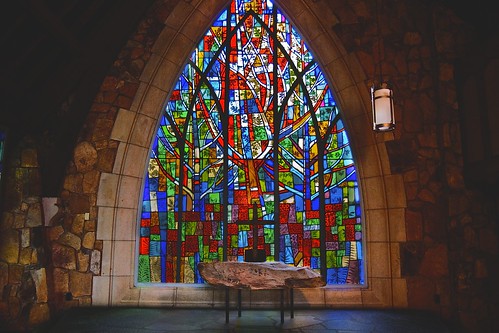
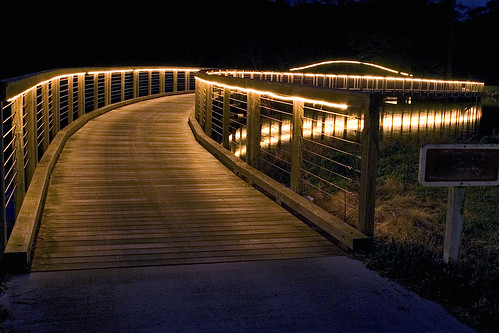
This image of light is dedicated to Charles Needle and to Mark S. Johnson, who cheerfully walked with me in the dark, patiently taught me about exposure, and, when I faltered, encouraged me to snap the shutter.
Charles Needle Photography
Mark S. Johnson Photography

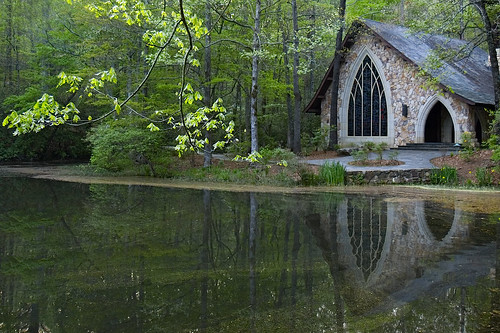
The small jewel-like chapel is the Ida Cason Callaway Memorial Chapel at Callaway Gardens in Pine Mountain, Georgia. It was planned by Cason Callaway as a tribute to his late mother. The stained glass windows were designed by Atlanta artist Joel Reeves.
Shown above is Alex Morley. An online gallery of some of his beautiful photographs can be viewed here.
And there is the dream of the pond, the only significant dream that originates in childhood, and also the only one that recurs from one year to another without the slightest change. And there is the dream of love, which it is pointless to burden with commentary since the only profound exegetes that this feeling has stirred until now are the organ and violoncello. These various dreams do not proceed, moreover, without concluding mutual alliances: the dreams of ambition, of love and death are frequently set within cathedrals, and the dream of the pond is also a dream of sacred terror. And there is the dream of melancholy happiness, recognizable in that it always unfolds beneath a certain rose sky, and the dream of absolute bliss, which I have dreamed but once, and where nothing transpires apart from an unforgettable blue color.
. . . The sleeper assembles images the way the poet assembles words: he makes use of them more or less felicitously to speak about himself to himself. Just as there are mutes, there are sleepers who do not dream; others dream badly, tritely, or by fits and starts: there are stuttering and verbose dreamers. Others, among whom it would be sheer ingratitude on my part not to count myself, sometimes receive the benefice of a beautiful dream, like those sorry poets whom chance occasionally grants the windfall of a verse that astonishes even them. Finally, there are perhaps sleepers of genius who dream with sublimity every night. If only we had at our disposal collections, museums of dreams, we could doubtlessly authenticate the existence of a Delacroix, a Leonardo da Vinci, or Watteau of the world of closed eyes.
-- Marguerite Yourcenar Dreams and Destinies
Translated by Donald Flanell Friedman
Marguerite Yourcenar
To the progenitors of myth, all appeared real, both their symbols and the objects of their symbols. They well understood that their gods were symbolical names for forces, yet those symbols were functioning as a part of reality nonetheless. Hence the Greek, the Christian, the Hindu, and the Mesopotamian never made the attempt to produce the likeness of reality as an end in itself in their art. Although they used a great deal of material which appealed to visual memory in a slighter or greater degree, which varied with times and places, their objective was never to reproduce the particular attributes of visual mechanics. Their representation of the gods, even when they partook more and more human characteristics (which is a common progression of the arts of Greece and India at least), are never attempts to produce the appearance of a man, but rather a reference to the genre of man.
Here an example from mathematics may be helpful. The letter x in algebra is definitely an abstraction in relationship to the numbers with which it can intermingle as a factor. It is true that the numbers are also an abstraction, yet x is even a further abstraction from the qualities of the numbers. Yet this letter functions in all of the calculations as a real quantity. In other words, we have a symbol which admittedly represents the unknown. Yet our faith in the system is so great—that is, our faith in the absolute relationships of all quantities—that we can affirm this symbol of the unknown as a definite, real, and calculable element. We might say that the Greeks understood the quality of the unknown, but so great was their faith in order that the unknown, although always symbolized, functioned for them as a part of reality, and entered as a real attribute in all their real relationships. Now, the substitution of the letter x, or in fact, of any of the numerical quantities by real objects, would immediately remove the whole relationship from the sphere of generality and place it into the particular, for real objects would introduce a host of qualities which would impress themselves upon our attention and consequently confuse the absoluteness of our equations.
In this sense, the Greek never particularized the objects which he introduced as vehicles for the statement of the plastic equivalent of unity. All the objects are made impersonal, having definite functions as symbols both in appearance and in the portion which they play in the anecdote. All the relationships are therefore symbolic. This is made manifest in the figures represented, whose attitudes and relationships toward not only each other, but in relation to the cosmogonic forces which they symbolize, are symbolic; the meaning of the symbol itself being identical with the notion of reality which the artist is to symbolize or to make manifest plastically.
Now, in the world of the painter, his sense of the essential and the infinite must be realized plastically. He must express his notions of reality in the terms of shapes, space, colors, rhythms, and the other plastic elements which we have previously described, for they constitute the language of painting, just as sound, timbres, and measures constitute that of the musician, or words and sentences that of the linguist. Or rather, the painter must represent them by the means of colored shapes arranged in certain rhythms constituting certain ideated and controlled movements toward a particular effect, this effect or end being the subject of his picture.
-- Mark Rothko The Artist's Reality
How pale the light was at the window! But that was nice. The fire rose and fell on the wall. It was like waves. Someone had put coal on and he heard voices. They were talking. It was the noise of the waves. Or the waves were talking among themselves as they rose and fell.
He saw the sea of waves, long dark waves rising and falling . . .
-- James Joyce A Portrait of the Artist as a Young Man
When we read the works of a great word dreamer like Michel Leiris (particularly in his Biffures), we find ourselves experiencing in words, on the inside of words, secret movements of our own. Like friendship, words sometimes swell, at the dreamer's will, in the loop of a syllable. While in other words, everything is calm, tight. Even as sober a man as Joseph Joubert recognizes the intimate repose of words when he speaks of certain ideas rather curiously as "huts." Words—I often imagine this—are little houses, each with its cellar and garret. Common-sense lives on the ground floor, always ready to engage in "foreign commerce," on the same level as the others, as the passers-by, who are never dreamers. To go upstairs in the word house, is to withdraw, step by step; while to go down to the cellar is to dream, it is losing oneself in the distant corridors of an obscure etymology, looking for treasures that cannot be found in words. To mount and descend in the words themselves—this is a poet's life. To mount too high or descend too low, is allowed in the case of poets, who bring earth and sky together.
-- Gaston Bachelard The Poetics of Space
Translated by Maria Jolas
Gaston Bachelard
Michel Leiris
Joseph Joubert

moeder met kind by Paula Modersohn-Becker
I must learn how to express the gentle vibration of things, their roughened textures, their intricacies . . . the strange quality of expectation that hovers over muted things; I must try to get hold of the great and simple beauty of all that. In general, I must strive for the utmost simplicity united with the most intimate power of observation.
-- Paula Modersohn-Becker The Letters and Journals
Translated by Arthur S. Wensinger and Carole Clew Hoey
about Paula Modersohn-Becker
Waking in the morning
Time smiles in my hand.
This dawn
lasts all day.
-- Deena Metzger
Deena Metzger
Gathas
They clung together in that bright moment of wonder, there on the magic island, where the world was quiet, believing all they said. And who shall say—whatever disenchantment follows—that we ever forget magic, or that we can ever betray on this leaden earth the apple tree, the singing, and the gold? Far out beyond that timeless valley, a train, on the rails for the East, wailed back its ghostly cry: life, like a fume of painted smoke, a broken wrack of cloud, drifted away. Their world was a singing voice again: they were young and they could never die. This would endure.
He kissed her on her splendid eyes; he grew into her young maenad's body, his heart numbed deliciously against the pressure of her narrow breasts. She was as lithe and yielding to his sustaining hand as a a willow rod—she was bird-swift, more elusive in repose than the dancing water motes upon her face. He held her tightly lest she grow into the tree again, or be gone among the wood like smoke.
Come up into the hills, O my young love: return. O lost, and by the wind grieved, ghost, come back again, as first I knew you in the timeless valley, where we shall find ourselves anew, bedded on magic in the month of June. There was a place where all the sun went glistering in your hair, and from the hill we could have put a finger on a star. Where is the day that melted into one rich noise? Where is the music of your flesh, the rhyme of your teeth, the dainty languor of your legs, your small firm arms, your slender fingers, to be bitten like an apple, and the little cherry-teats of your white breasts? And where are all the tiny wires of fine-spun maidenhair? Quick are the mouths of earth, and quick the teeth that fed upon this loveliness. You who were made for music, will music hear no more: in your dark house the winds are silent. Ghost, ghost, come back from that marriage that we did not foresee, return not into life, but into magic, where we have never died, in the enchanted wood, where we lie still, strewn on the grass. Come up into the hills, O my young love: return. O lost, and by the wind grieved, ghost, come back again.
-- Thomas Wolfe O Lost (the original version of Look Homeward, Angel)
O Lost