


Friday, September 30
IV.
In our consciousness of time
we are doomed to the past.
The future we may dream of
but can know it only after
it has come and gone.
The present too we know
only as the past. When
we say, "This now is
present, the heat, the breeze,
the rippling water," it is past.
Before we knew it, before
we said "now," it was gone.
If the only time we live
is the present, and if the present
is immeasurably short (or
long), then by the measure
of the measurers we don't
exist at all, which seems
improbably, or we are
immortals, living always
in eternity, as from time to time
we hear, but rarely know.
You see the rainbow and the new-leafed
woods bright beneath, you see
the otters playing in the river
or the swallows flying, you see
a beloved face, mortal
and alive, causing the heart
to sway in the rift between beats
where we live without counting,
where we have forgotten time
and have forgotten ourselves,
where eternity has seized us
as its own. This breaks
open the little circles
of the humanly known and believed,
of the world no longer existing,
letting us live where we are,
as in the deepest sleep also
we are entirely present,
entirely trusting, eternal.
Is it concentration of the mind,
our unresting counting
that leaves us standing
blind in our dust?
In time we are present only
by forgetting time.
-- Wendell Berry, from 2007
Wendell Berry

Monday, August 29
You never look at me from the place from which I see you.
Jacques Lacan 'Of the Gaze as Objet Petit a'
Tr. Alan Sheridan
Jacques Lacan
Friday, August 26
Thursday, August 25
The secret of the image...must not be sought in its differentiation from reality, and hence in its representative value (aesthetic, critical or dialectical), but on the contrary in its 'telescoping' into reality, its short-circuit with reality, and finally, in the implosion of image and reality.
-- Jean Baudrillard, The Evil Demon of Images
Tr. Paul Patton and Paul Foss
Jean Baudrillard
Friday, July 8
From a Phrase of Simone Weil's and Some Words of Hegel's
In back deep the jewel
The treasure
No Liquid
Pride of the living life's liquid
Pride in the sandspit wind this ether this other this element all
It is I or I believe
We are the beaks of the ragged birds
Tune of the ragged bird's beaks
In the tune of the winds
Ob via the obvious
Like a fire of straws
Aflame in the world or else poor people hide
Yourselves together Place
Place where desire
Lust of the eyes the pride of life and foremost of the storm's
Multitude moves the wave belly-lovely
Glass of the glass sea shadow of water
On the open water no other way
To come here the outer
Limit of the ego
-- George Oppen
Listen
Wednesday, June 29
[And Leaving In a Great Smoky Fury]
And leaving in a great smoky fury
of his loved ones, he sailed
backwards to Europe discovering islands,
the pale ones and the ones like
elephants and those like pearls.
But the trees shall stand never
so high as in his native land!
they hoped, but he found ruins and
aqueducts and fountains, and loved them.
-- Frank O'Hara
Frank O'Hara
Friday, May 27
Prime
I don't believe that you made me
into this tremolo of hands,
this fever, this flat-footed dance
of tendons and the drapery
of skin along a skeleton.
I am that I am: a brittle
rib cage and the hummingbird
of breath that flickers in it.
Incrementally, I stand:
in me are eons and the cramp
of endless ancestry.
Sun is in the leaves again.
I think I see you in the wind
but then I think I see the wind.
-- Malachi Black
Malachi Black
Sunday, May 22
Thursday, May 19
YIELD Everything, Force Nothing
Years circling the same circle:
the call to be first,
and the underlying want:
and this morning, look! I've finished now,
with this terrific red thing,
with green and yellow rings on it, and stars.
The contest is over:
I turned away,
and I am beautiful: Job's last daughters,
Cinnamon, Eyeshadow, Dove.
The contest is over:
I let my hands fall,
and here is your garden:
Cinnamon, Eyeshadow, Dove.
-- Jean Valentine
Jean Valentine
Tuesday, May 17
MoMA Online Courses- Online Registration now open!
Ticking by Mab MacMoragh
How do the online courses work?Read more and register
These 10-week classes can be accessed at times that are convenient for you; there is no set time when participants are required to log in. Each week, starting with the first week of class and continuing for nine subsequent weeks, students participate in lively discussion forums with one another and the instructor. The courses provide unique videos, slide shows, and readings.
Artist Deborah Rhee looks back on her experience with MoMA Online Learning as part of the Materials and Techniques studio painting course taught by Corey d'Augustine and comes away with a thumbs-up!
Read Deborah's blog post
(crossposted)
Monday, May 9
What He Thought
We were supposed to do a job in Italy
and, full of our feeling for
ourselves (our sense of being
Poets from America) we went
from Rome to Fano, met
the Mayor, mulled a couple
matters over. The Italian literati seemed
bewildered by the language of America: they asked us
what does "flat drink" mean? and the mysterious
"cheap date" (no explanation lessened
this one's mystery). Among Italian writers we
could recognize our counterparts: the academic,
the apologist, the arrogant, the amorous,
the brazen and the glib. And there was one
administrator (The Conservative), in suit
of regulation gray, who like a good tour guide
with measured pace and uninflected tone
narrated sights and histories
the hired van hauled us past.
Of all he was most politic--
and least poetic-- so
it seemed. Our last
few days in Rome
I found a book of poems this
unprepossessing one had written: it was there
in the pensione room (a room he'd recommended)
where it must have been abandoned by
the German visitor (was there a bus of them?) to whom
he had inscribed and dated it a month before. I couldn't
read Italian either, so I put the book
back in the wardrobe's dark. We last Americans
were due to leave
tomorrow. For our parting evening then
our host chose something in a family restaurant,
and there we sat and chatted, sat and chewed, till,
sensible it was our last big chance to be Poetic, make
our mark, one of us asked
"What's poetry?
Is it the fruits and vegetables
and marketplace at Campo dei Fiori
or the statue there?" Because I was
the glib one, I identified the answer
instantly, I didn't have to think-- "The truth
is both, it's both!" I blurted out. But that
was easy. That was easiest
to say. What followed taught me something
about difficulty,
for our underestimated host spoke out
all of a sudden, with a rising passion, and he said:
The statue represents
Giordano Bruno, brought
to be burned in the public square
because of his offence against authority, which was to say
the Church. His crime was his belief
the universe does not revolve around
the human being: God is no
fixed point or central government
but rather is poured in waves, through
all things: all things
move. "If God is not the soul itself,
he is the soul OF THE SOUL of the world." Such was
his heresy. The day they brought him forth to die
they feared he might incite the crowd (the man
was famous for his eloquence). And so his captors
placed upon his face
an iron mask
in which he could not speak.
That is how they burned him.
That is how he died,
without a word,
in front of everyone. And poetry--
(we'd all put down our forks by now, to listen to
the man in gray; he went on softly)-- poetry
is what he thought, but did not say.
-- Heather McHugh
Hear Heather McHugh read this poem at Poets.org
Giordano Bruno at Wikipedia
Sunday, May 8
The Parcel
There are dying arts and
one of them is
the way my mother used to make up a parcel.
Paper first. Mid-brown and course-grained as wood.
The worst sort for covering a Latin book neatly
or laying flat at Christmas on a pudding bowl.
It was a big cylinder. She snipped it open
and it unrolled quickly across the floor.
All business, all distance.
Then the scissors.
Not a glittering let-up but a dour
pair, black thumb-holes,
the shears themselves the colour of the rained-
on steps a man with a grindstone climbed up
in the season of lilac and snapdragon
and stood there arguing the rate for
sharpening the lawnmower and the garden pair
and this one. All-in.
The ball of twine was coarsely braided
and only a shade less yellow than
the flame she held under the blunt
end of the sealing wax until
it melted and spread into a brittle
terracotta medal.
Her hair dishevelled, her tongue between her teeth,
she wrote the address in the quarters
twine had divided the surface into.
Names and places. Crayon and fountain pen.
The town underlined once. The country twice.
It's ready for the post
she would say and if we want to know
where it went to–
a craft lost before we missed it–watch it go
into the burlap sack for collection.
See it disappear. Say
this is how it died
out: among doomed steamships and outdated trains,
the tracks for them disappearing before our eyes,
next to station names we can't remember
on a continent we no longer
recognize. The sealing wax cracking.
The twine unraveling. The destination illegible.
-- Eavan Boland
Eavan Boland : The Poetry Foundation
Friday, April 8
A year—& through branches light comes,
A pilgrim out of March from a farther world.
There is a flaw in the air. I breathed it
From the swamp, a kiss of damp
Translated to a plague that would remote me
From care & corroding solicitudes, crown me
With this headdress of red-painted deer-hair
& weight my ears with wheels of copper.
My face painted blue & silver, my body
Washed in crimson dye, they would greet me
First with lamentations to mourn my old life,
Then by psalms I could enter
Purged & reborn & singing in a tongue
Not mine I know not where to go. (I know.)
-- Averill Curdy, from 'Ovid in America'
Averill Curdy
Thursday, March 24
Thursday, March 17
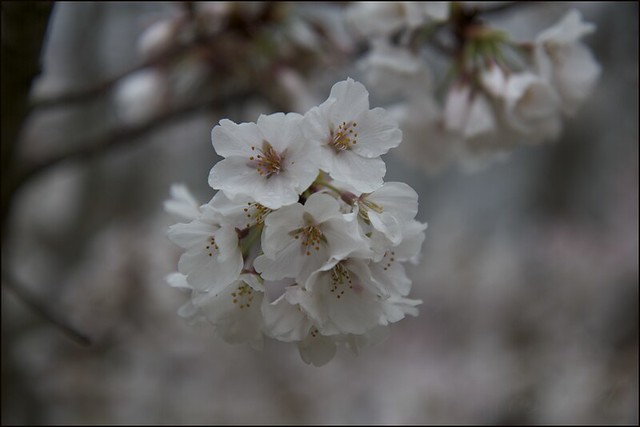
Loveliest of Trees, the Cherry Now
Loveliest of trees, the cherry now
Is hung with bloom along the bough,
And stands about the woodland ride
Wearing white for Eastertide.
Now, of my threescore years and ten,
Twenty will not come again,
And take from seventy springs a score,
It only leaves me fifty more.
And since to look at things in bloom
Fifty springs are little room,
About the woodlands I will go
To see the cherry hung with snow.
-- A.E. Housman
Sunday, January 16
Monday, January 10
The Snow Man
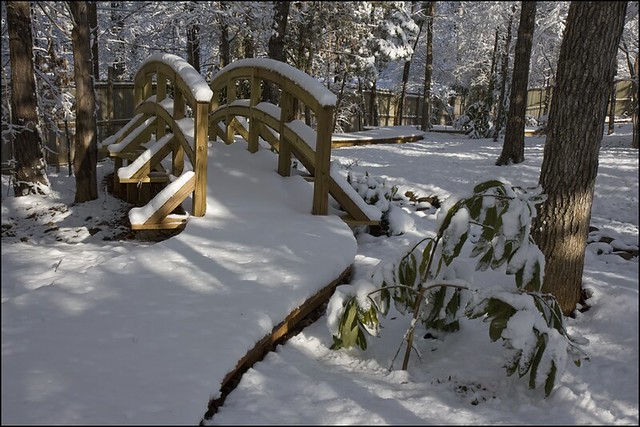
One must have a mind of winter
To regard the frost and the boughs
Of the pine-trees crusted with snow;
And have been cold a long time
To behold the junipers shagged with ice,
The spruces rough in the distant glitter
Of the January sun; and not to think
Of any misery in the sound of the wind,
In the sound of a few leaves,
Which is the sound of the land
Full of the same wind
That is blowing in the same bare place
For the listener, who listens in the snow,
And, nothing himself, beholds
Nothing that is not there and the nothing that is.
-- Wallace Stevens
On "The Snow Man"
Friday, December 31
Thursday, December 30
From A Notebook
The whiteness near and far.
The cold, the hush . . .
A first word stops
The blizzard, steps
Out into fresh
Candor. You ask no more.
Each never taken stride
Leads onward, though
In circles ever
Smaller, smaller.
The vertigo
Upholds you. And now to glide
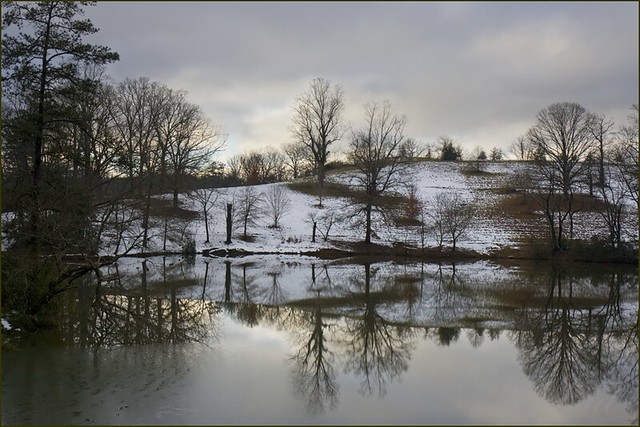
Across the frozen pond,
Steelshod, to chase
Its dreamless oval
With loop and spiral
Until (your face
Downshining, lidded, drained
Of any need to know
What hid, what called,
Wisdom or error,
Beneath that mirror)
The page you scrawled
Turns. A new day. Fresh snow.
-- James Merrill, from Collected Poems
Collected Poems
Sunday, December 26
Friday, December 24
That night frost stretched
the fields into stiff white sheets;
from post, strut and roof glinting
ice-fingers pointed to the ground.
But within walls, reed-woven,
mud-baked, we warded off
the wind-beast's bellow and bite.
Herded in the wool of our own warmth,
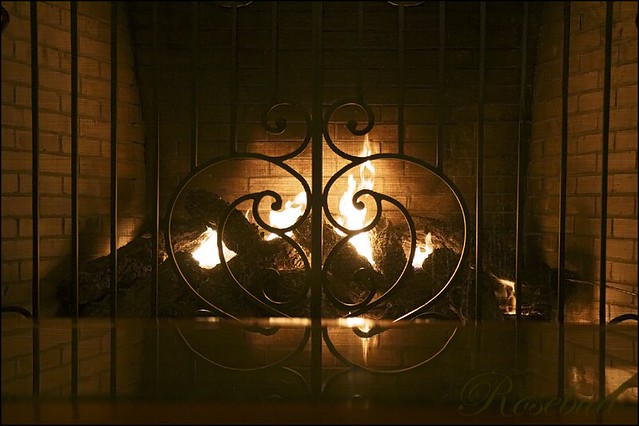
near red-gold flames that licked
logs, then leapt to find the hole
to heaven, we defeated winter's pikes.
That festive night we filled
our bodies' troughs with roasted meats,
with mead that honeys the senses, muzzes
the mind. As ever I kept quiet,
stoked myself with the comfort rising
from the rush-strewn floor, the goodwill
steaming through talk and laughter.
-- Myra Schneider, from 'Caedmon'
Interview with Myra Schneider
Cædmon
Cædmon's Hymn
Thursday, December 23
#258
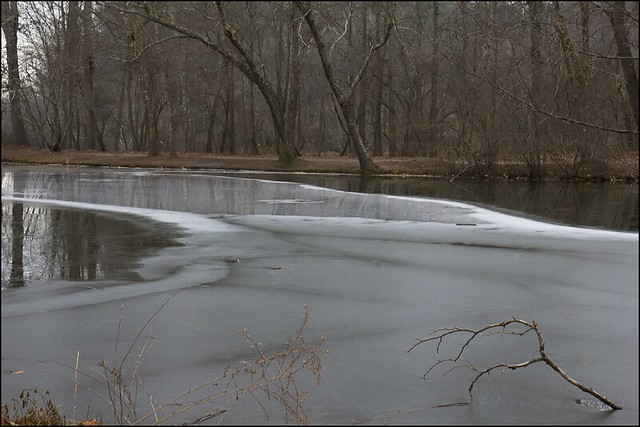
There's a certain Slant of light,
Winter Afternoons–
That oppresses, like the Heft
Of Cathedral Tunes–
Heavenly Hurt, it gives us–
We can find no scar,
But internal difference,
Where the Meanings, are.
None may teach it –Any–
'Tis the Seal, Despair–
An imperial affliction
Sent us of the air–
When it comes, the Landscape listens–
Shadows– hold their breath–
When it goes, 'tis like the Distance
On the look of Death–
-- Emily Dickinson
Read: 'Forms of Reticence' by Saskia Hamilton
Friday, December 17
Saturday, December 11
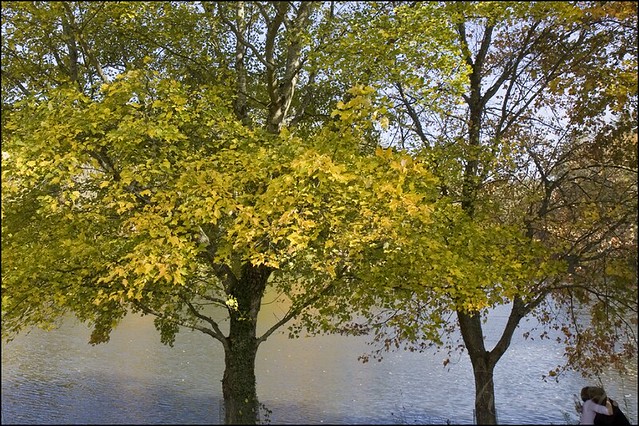
late shadows gather in the dark
words unwrite
as they are written
unspeak
as they are spoken
songs sprung
from heart and lung
to tongue
unsung
drunk winds stumble over shuffling roofs
shake his sleep who dreams
a lost love
will not
let
go
recurring swirls
of old gold
blown light
you can't help
but be in it
as it opens
and falls back on itself
unfolds and unsays
I do not want to die
without writing the unwritten
pleasure of water
-- Tom Pickard, lines from "Lark & Merlin"
Lark & Merlin
Thursday, November 25
Soup
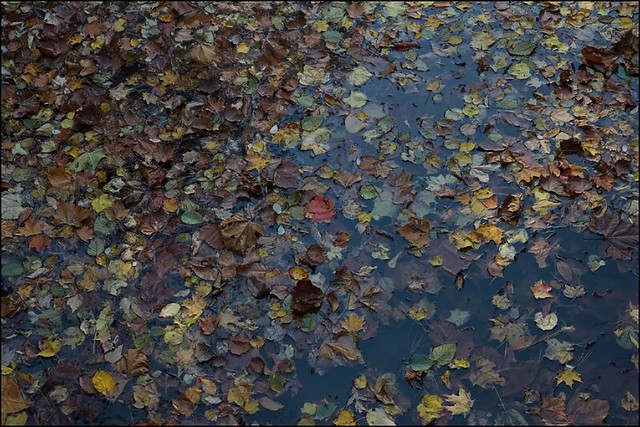
I make soup and name the seasonings:
parsley, the damp tears that,
homesick, I planted in the loved earth.
Tiny black pepper eyes. Mice in the walls,
the bullets we will have to bite,
sharp clove stars inside the blue pillow
I put over my feet every night
so nothing gets away. I add
sweet basil, mint or saint;
a small procession of bay leaf,
laurel. Salt stream, salt water,
sea anemone. The chatter of barnacles
stuck to the rocks, gull cry and kestrel.
Chicken carcass, soft bone marrow,
once feathered, this bed
for vegetables I know to speak to:
the riven onions, train whistle.
Limp celery stalks I hold up to the light
and try to see through, cold hands.
Potato skins, weathered leather,
cinched saddles and compost.
Rutabaga, sore toe, a sudden
drop in barometric pressure,
rich Minnesota farmland
where yellow leaves were swept
across the burned fields.
What floats through the blue air
is feathers, is white rice,
falling into pottage, into hunger,
wet snow that vanishes,
the steaming ground.
-- Maggie Anderson
Maggie Anderson
Saturday, November 6
Wednesday, November 3
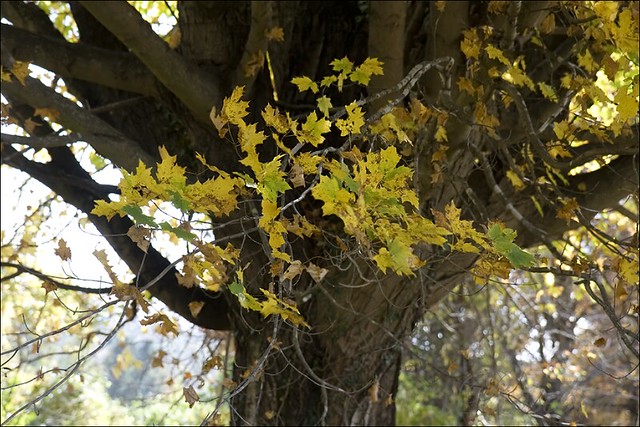
sometimes it is necessary
to reteach a thing its loveliness
--Galway Kinnell, lines from "Saint Francis and the Sow"
Saint Francis and the Sow
Thursday, October 7
Between embryo, corpse, the compelled child,
The youth growing, the education in questions,
The man of imperatives, the ontological predicament–
In the population of forms he came naming them
Because the idea requires the idea.
There is never anything more truthful
Than what you yourself make of it
Except the possibility that is always there
Behind you, at the back of the mirror,
Behind the brain, in back of the universe–
And that also as you will make it.
–Came into the delivered air
Crying the violence: there was the storm in the heart of the flower,
The perpetually new diagram in the snowflake, the explosion
Locked in a drop of water.
The population of forms outran guesses:
There was the garden, the tree,
The fruit he was forbidden to eat.
-- Peyton Houston, lines from The Changes
Tuesday, August 31
So what can they tell us, the writers of dream books,
the scholars of oneiric signs and omens,
the doctors with couches for analyses–
if anything fits,
it's accidental,
and for one reason only,
that in our dreamings,
in their shadowings and gleamings,
in their multiplings, inconceivablings,
in their haphazardings and widescatterings
at times even a clear-cut meaning
may slip through.
-- Wislawa Szymborska, lines from Dreams
Tr. Clare Cavanagh and Stanislaw Baranczak
Saturday, August 14
Thursday, August 5
Tuesday, August 3
... writing is, among other things, an activity which discovers its object; which surprises itself with the meanings it runs into, and passes sometimes with apologies, or recognizes with a start like an old friend encountered in a strange place.
-- William H. Gass, from the Introduction to The Notebooks of Malte Laurids Brigge by Rainer Maria Rilke (Tr. Stephen Mitchell)
Sunday, August 1
Saturday, July 31
In the world of eternal return the weight of unbearable responsibility lies heavy on every move we make. That is why Nietzsche called the idea of eternal return the heaviest of burdens (das schwerste Gewicht).
If eternal return is the heaviest of burdens, then our lives can stand out against it in all their splendid lightness.
But is heaviness truly deplorable and lightness splendid?
The heaviest of burdens crushes us, we sink beneath it, it pins us to the ground. But in the love poetry of every age, the woman longs to be weighed down by the man's body. The heaviest of burdens is therefore simultaneously an image of life's most intense fulfillment. The heavier the burden, the closer our lives come to the earth, the more real and truthful they become.
Conversely, the absolute absence of a burden causes man to be lighter than air, to soar into the heights, take leave of the earth and his earthly being, and become only half real, his movements as free as they are insignificant.
What then shall we choose? Weight or lightness?
-- Milan Kundera The unbearable lightness of being
The unbearable lightness of being
Saturday, July 24

Hamm: ...One day you'll be blind, like me. You'll be sitting there, a speck in the void, in the dark, for ever, like me. (Pause.) One day you'll say to yourself, I'm tired, I'll sit down, and you'll go and sit down. Then you'll say, I'm hungry, I'll get up and get something to eat. But you won't get up. You'll say, I shouldn't have sat down, but since I have I'll sit on a little longer, then I'll get up and get something to eat. But you won't get up and you won't get anything to eat. (Pause.) You'll look at the wall a while, then you'll say, I'll close my eyes, perhaps have a little sleep, after that I'll feel better, and you'll close them. And when you'll open them again there will no wall anymore. (Pause.) Infinite emptiness will be all around you, all the resurrected dead of all the ages wouldn't fill it, and there you'll be like a little bit of grit in the middle of the steppe...
Clov: It's not certain...
Hamm: Well, you'll lie down then, what the hell! Or you'll come to a standstill, simply stop and stand still, the way you are now. One day you'll say, I'm tired, I'll stop. What does the attitude matter?
-- Samuel Beckett Endgame
Endgame
Friday, July 16
Thursday, July 15
Wednesday, July 14
Monday, July 12
It is other. The place resonates a quality that you respond to. You feel your self in relation to its otherness. It's like the infinity sign–the distance is so great that it comes back on itself. At a given moment it's the way the light caresses the buildings, the way the chip of the horizon appears in the alleyway; it's the waving of the grass; it's the snap of the curtain. It's everything. It's one whole. At that moment, you step past, into that whole, and it swallows you up.
-- Joel Meyerowitz Cape Light: Color Photographs
Joel Meyerowitz
Saturday, July 10
Tuesday, July 6
Eurydice. Heurtebise! Will you explain this miracle?
Heurtebise. What miracle?
Eurydice. You're not going to tell me you haven't noticed anything, and that it is natural to remain suspended in midair instead of falling, when a chair is taken from under you?
Heurtebise. Suspended in midair?
Eurydice. You needn't make out you are surprised, because I saw you. You stayed in midair. You stayed there two feet above the floor, with only emptiness round you.
Heurtebise. You really do surprise me.
Eurydice. You remained a good minute between heaven and earth.
Heurtebise. Impossible.
Eurydice. Exactly. That's why you owe me an explanation.
Heurtebise. You mean to say that I stayed without a support between the ceiling and the floor?
Eurydice. Don't tell a lie, Heurtebise! I saw you, I saw you with my own eyes. I had the greatest difficulty in stifling a cry. In this madhouse, you were my last refuge, you were the only person who didn't frighten me, in your presence I regained my balance. It's all very well living with a horse that talks, but a friend who floats in the air becomes of necessity an object of suspicion. Don't come near me. At the moment even your glistening back gives me gooseflesh. Explain yourself, Heurtebise! I am listening.
Heurtebise. I have no need to defend myself. Either I am dreaming or you have dreamt.
Eurydice. Yes, such things do happen in dreams, but neither of us was asleep.
Heurtebise. You must have been the dupe of the mirage between my windowpanes and yours. Things do lie at times. At the fair I saw a naked woman walking along the ceiling.
Eurydice. This was nothing to do with a machine. It was beautiful and outrageous. For the space of a second I saw you as outrageous as an accident and as beautiful as a rainbow. You were the cry of a man who falls from a window, and you were the silence of the stars. You frighten me. I'm too frank not to tell you. If you do not wish to answer me, you needn't, but our relationship can never be the same. I thought you were simple, but you are complex. I thought you were of my race, but you are of the race of the horse.
-- Jean Cocteau Orphée (The play)
Tr. Carl Wildman
Jean Cocteau
Friday, July 2
Lindenbloom
Before midsummer density
opaques with shade the checker-
tables underneath, in daylight
unleafing lindens burn
green-gold a day or two,
no more, with intimations
of an essence I saw once,
in what had been the pleasure-
garden of the popes
at Avignon, dishevel
into half (or possibly three-
quarters of) a million
hanging, intricately
tactile, blond bell-pulls
of bloom, the in-mid-air
resort of honeybees'
hirsute cotillion
teasing by the milligram
out of those necklaced
nectaries, aromas
so intensely subtle,
strollers passing under
looked up confused,
as though they'd just
heard voices, or
inhaled the ghost
of derelict splendor
and/or of seraphs shaken
into pollen dust
no transubstantiating
pope or antipope could sift
or quite precisely ponder.
-- Amy Clampitt
Amy Clampitt
Sunday, June 13
Saturday, May 22
Friday, May 14
Night Music
I think of the nightfall all the time.
I think of the dark pine trees
leaning out of the sky
Backlit by diminishing twilight, then not backlit.
I think of the way the tree frogs pitch
And pull in their summer dance.
I think of how the wind comes in from thousands of miles away.
I think of how the darkness abides.
The world's a slick rock we've got to cross,
The air, as Cavalcanti says, tremulous with light
And everywhere nicked with voices and little outcries.
Whose are they, and who are they,
their wings horizon edged,
Their bodies as soft as clouds, their skins tattooed and laid bare and
Graffitied with desolation?
Dreams of them enter, like things alive, the rooms where our loves lie
sleeping.
Listen to what the book says–
Woe to you because of the fire that burns in you, for it is insatiable.
Woe to you because of the wheel that turns in your mind.
This is the way the night comes on,
a narrow and shapeless place,
A few rehearsals among the insects, a few stars,
The thing invisible brought to naught, and back among visible things.
This is the way it all ends.
-- Charles Wright A Short History of the Shadow
Charles Wright
Sunday, May 9
if there are any heavens my mother will (all by herself) have
one. It will not be a pansy heaven nor
a fragile heaven of lilies-of-the-valley but
it will be a heaven of blackred roses
my father will be (deep like a rose
tall like a rose)
standing near my
(swaying over her
silent)
with eyes which are really petals and see
nothing with the face of a poet really which
is a flower and not a face with
hands
which whisper
This is my beloved my
(suddenly in sunlight
he will bow,
& the whole garden will bow)
- E.E. Cummings
Monday, May 3
Sunday, May 2
Friday, April 30
Tuesday, April 27
Monday, April 26
When I was a boy I used to think that things progressed by contrasts, that there was a law of contrasts. But this was building the world out of blocks. Afterwards I came to think of the energizing that comes from mere interplay, interaction. Thus, the various faculties of the mind co-exist and interact, and there is as much delight in this mere co-existence as man and woman find in each other's company . . . Cross reflections, modifications, counter-balances, complements, giving and taking are illimitable. They make things inter-dependent and their inter-dependence sustains them and gives them pleasure.
-- Wallace Stevens, 1940 Letter to Hi Simons
Saturday, April 24
And yet the perfect poem can only materialize on condition that this world, acted upon by all five levers [senses] simultaneously, is seen, under a definite aspect, on the supernatural plane, which is, in fact, the plane of the poem . . . But the lover is in such splendid danger just because he must depend on the coordination of his senses, for he knows that they must meet in that unique and risky center in which, renouncing all extension, they come together and have no permanence . . . If the world's whole field of experience, including those spheres which are beyond our knowledge, be represented in a complete circle, it will be immediately evident that when the black sectors, denoting that which we are incapable of experiencing, are measured against the lesser, light sections, correspond to that which is illuminated by the senses, the former are very much greater.
Now the position of the lover is this: that he feels himself unexpectedly placed in the center of the circle, that is to say, at the point where the known and the incomprehensible, coming forcibly together at one single point, become complete and simply a possession, losing thereby, it is true, all individual character . . . As the lover's danger consists in the nonspatial character of his standpoint, so the poet's lies in his awareness of the abysses which divide the one order of sense experience from the other: in truth they are sufficiently wide and engulfing to sweep away from before us the greater part of the world–who knows how many worlds?
-- Rainer Maria Rilke "Primal Sound"
Tr. G. Craig Houston
Wednesday, April 7
In the case of the transcendent, the mystery is what promises to unveil itself in the wake of the apocalyptic passing of reality. With the enigma, the self faces its limit, envisions the end of worlds in order to escape their tyranny. Transformation means the rupture of the ordinary domains and patterns of authority, the dense cityscape of doxa that conduct the traffic of thought. Transformation portends the possibility of an alternate self and social order, while enigma preserves a radical open-endedness, vigorously resists perfection in the sense of ontological completion or metaphysical resolution. But in either mystery or enigma, transcendence or transformation, something must die in order for something new to live. Death and rebirth and their dialectic of conflict are the characteristic moments of the human self and the principle features of spirituality and its artistic evocation.
-- David Morgan, from "Secret Wisdom and Self-Effacement: The Spiritual in the Modern Age" Negotiating Rapture: The Power of Art to Transform Lives
Wednesday, March 24
Tuesday, March 23
The crater's spaces will be filled with starlight. For me, this has a very elegant quality because there are stars that are billions of years old and there is starlight that's fairly recent, maybe only twenty light years old. Other starlight has taken millions or billions of light years to get there. So you can mix this light of different ages, which has a physical presence, which speaks of its time…
-- James Turrell, on Roden Crater, in Parkett 25
James Turrell (link)
Roden Crater (link)
Parkett (link)
Monday, March 8
Wednesday, February 24
I think then no one can admire the beauty of the body more than I do, and it is of course a comfort to find beauty in a friend or a friend in beauty. But this kind of beauty is dangerous. Then comes the beauty of the mind, such as genius, and this is greater than the beauty of the body and not to call dangerous. And more beautiful than the beauty of the mind is the beauty of the character, the "handsome heart."
-- Gerard Manley Hopkins, letter to Robert Bridges, 25 October 1879
Friday, February 19
Man is his own star; and the soul that can
Render an honest and a perfect man,
Commands all light, all influence, all fate;
Nothing to him falls early or too late.
Our acts our angels are, or good or ill,
Our fatal shadows that walk by us still.
-- Francis Beaumont and John Fletcher The Honest Man's Fortune
The Honest Man's Fortune (link)
Saturday, February 13
Saturday, February 6
Except in a vacuum, silence does not exist. Outside laboratory conditions, perfect sine tones and absolute white noise can't be found. The harmonic series is another elegant conceptual construction that we believe should exist. We hear portions of the harmonic series all the time, in our musical instruments and occasionally in the larger world around us. But we never hear it in full, mathematically pristine form.
The harmonic series, sine tones, white noise, absolute silence: these ideals of sound tantalize the mind's ear. But the world is richer, subtler, more nuanced and more complex than we imagine. Almost nothing we hear conforms to the patterns we construct.
-- John Luther Adams, from "A Composer's Journal, Part II–Studio Notes," February 9, 2005 The Place Where You Go to Listen
Wednesday, February 3
We can think about art. We can write and talk and argue about art. We can use art as a vehicle to convey our ideas and our beliefs. But at a certain point, art has to stand on its own. To support real meaning, art must first and foremost be itself.
-- John Luther Adams, from "A Composer's Journal, Part II–Studio Notes," January 30, 2005 The Place Where You Go to Listen
Saturday, January 23
Sunday, January 10
O you tender ones, walk now and then
into the breath that blows coldly past.
Upon your cheeks let it tremble and part;
behind you it will tremble together again.
O you blessed ones, you who are whole,
you who seem the beginning of hearts,
bows for the arrows and arrows' targets–
tear-bright, your lips more eternally smile.
Don't be afraid to suffer; return
that heaviness to the earth's own weight;
heavy are the mountains, heavy are the seas.
Even the small trees you planted as children
have long since become too heavy; you could not
carry them now. But the winds . . . But the spaces . . .
-- Rainer Maria Rilke, from The Sonnets to Orpheus
Tr. Stephen Mitchell
Friday, January 1
A true noun, an isolated thing, does not exist in nature. Things are only the terminal points, or rather the meeting points, of actions, cross-sections cut through actions, snapshots. Neither can a pure verb, an abstract motion, be possible in nature. The eye sees noun and verb as one : things in motion, motion in things . . .
-- Ernest Fenollosa The Chinese Written Character as a Medium for Poetry
Ed. Ezra Pound
The Chinese Written Character as a Medium for Poetry (link)
Thursday, December 31
Year's End
Now winter downs the dying of the year,
And night is all a settlement of snow;
From the soft street the rooms of houses show
A gathered light, a shapen atmosphere,
Like frozen-over lakes whose ice is thin
And still allows some stirring down within.
I've known the wind by water banks to shake
The late leaves down, which frozen where they fell
And held in ice as dancers in a spell
Fluttered all winter long into a lake;
Graved on the dark in gestures of descent,
They seemed their own most perfect monument.
There was perfection in the death of ferns
Which laid their fragile cheeks against the stone
A million years. Great mammoths overthrown
Composedly have made their long sojourns,
Like palaces of patience, in the gray
And changeless lands of ice. And at Pompeii
The little dog lay curled and did not rise
But slept the deeper as the ashes rose
And found the people incomplete, and froze
The random hands, the loose unready eyes
Of men expecting yet another sun
To do the shapely thing they had not done.
These sudden ends of time must give us pause.
We fray into the future, rarely wrought
Save in the tapestries of afterthought.
More time, more time. Barrages of applause
Come muffled from a buried radio.
The New-year bells are wrangling with the snow.
-- Richard Wilbur
Richard Wilbur (link)
Thursday, December 24
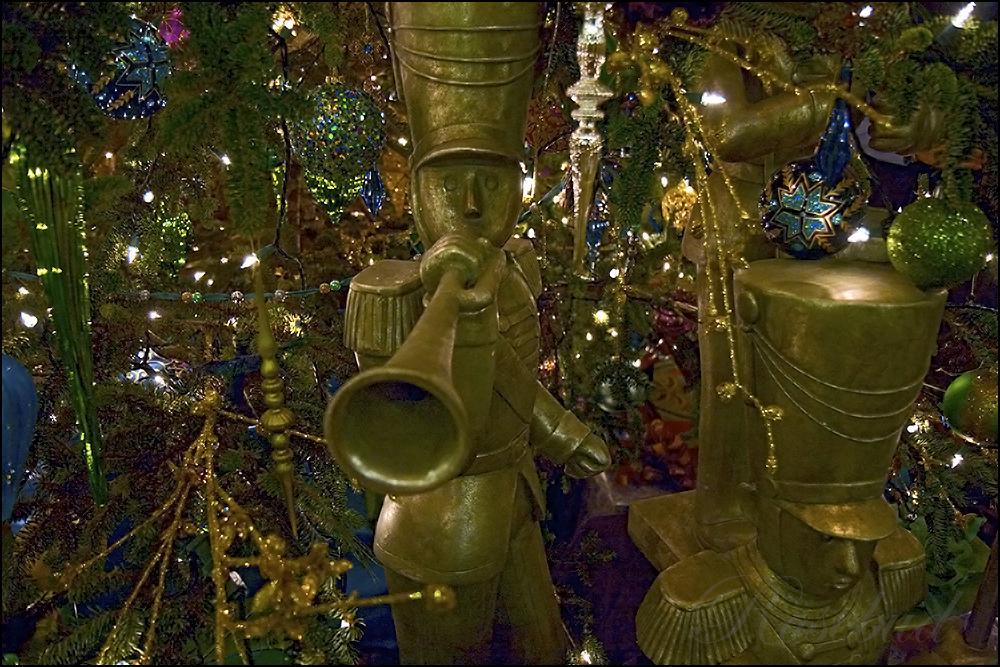
Christmas Trees
Bonhoeffer in his skylit cell
bleached by the flares' candescent fall,
pacing out his own citadel,
restores the broken themes of praise,
encourages our borrowed days,
by logic of his sacrifice.
Against the wild reasons of the state
his words are quiet but not too quiet.
We hear too late or not too late.
-- Geoffrey Hill
About Dietrich Bonhoeffer and "Christmas Trees" (link)
Geoffrey Hill (link)
Monday, December 21
Sunday, December 20
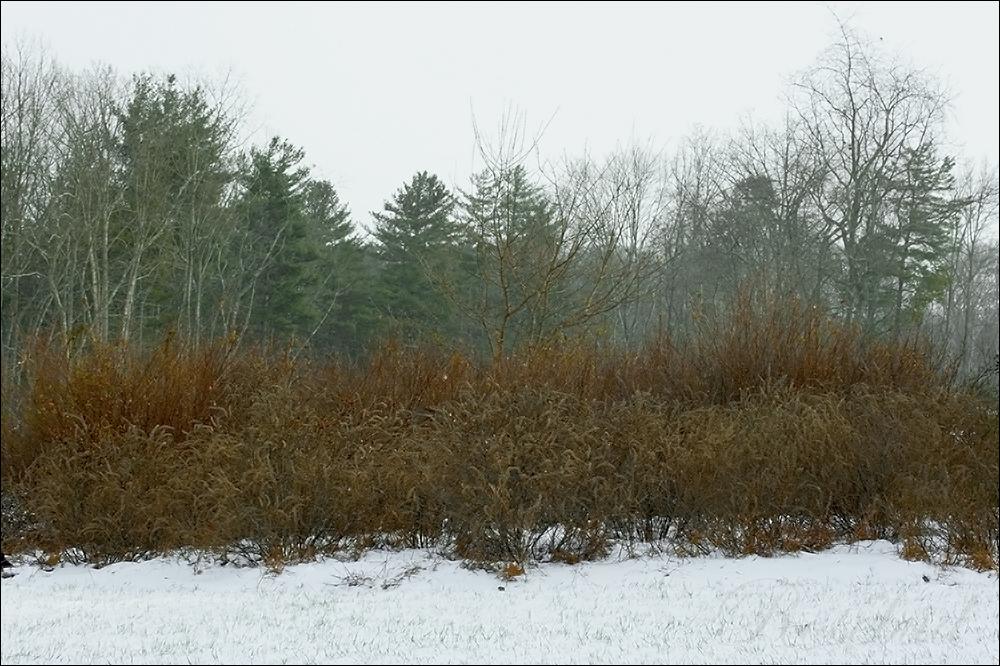
To a Leaf Falling in Winter
At sundown when a day's words
have gathered at the feet of the trees
lining up in silence
to enter the long corridors
of the roots into which they
pass one by one thinking
that they remember the place
as they feel themselves climbing
away from their only sound
while they are being forgotten
by their bright circumstances
they rise through all of the rings
listening again
afterward as they
listened once and they come
to where the leaves used to live
during their lives but have gone now
and they too take the next step
beyond the reach of meaning
-- W.S. Merwin
W.S. Merwin (link)
Friday, December 11
do not be ashamed if at times your eyes fill with tears (it's good for you)
… tonight we are privileged to undertake Rachmaninov's "All-Night Vigil." Those of you who have baby sitters who expect you home before dawn may wish to step outside for a few moments to make a phone call. (Lest you be frightened by the title, be apprised that the 15 musical numbers take but 65 minutes in the singing.)
Though written during the early years of World War I (1915), with the restrictions which Rachmaninov imposed upon himself to insure their suitability for liturgical performance, their musical idiom clearly "looks backward" –to the 500-year-old orthodox Znamenny chant as clothed in the loving 19th century language of "the last great representative of Russian Romanticism."
… Ranging from unison voices to eight and twelve parts, and moving from simple chant through variation to improvisation, the Vespers sometimes can be a complex work to put together, but it speaks so directly and simply to the heart, that one of the recurrent difficulties in rehearsal is that we become so emotionally touched–that it is next to impossible to continue singing.
Do not be ashamed if at times your eyes fill with tears (it's good for you)
And it almost certainly is best if we withhold applause until the Vespers are complete. We will not be insulted if even then you do not applaud.
-- Robert Shaw, from "Opening Remarks at Spivey Hall," May 14-15, 1993 The Robert Shaw Reader
All-Night Vigil (link)
Monday, December 7
Sunday, December 6
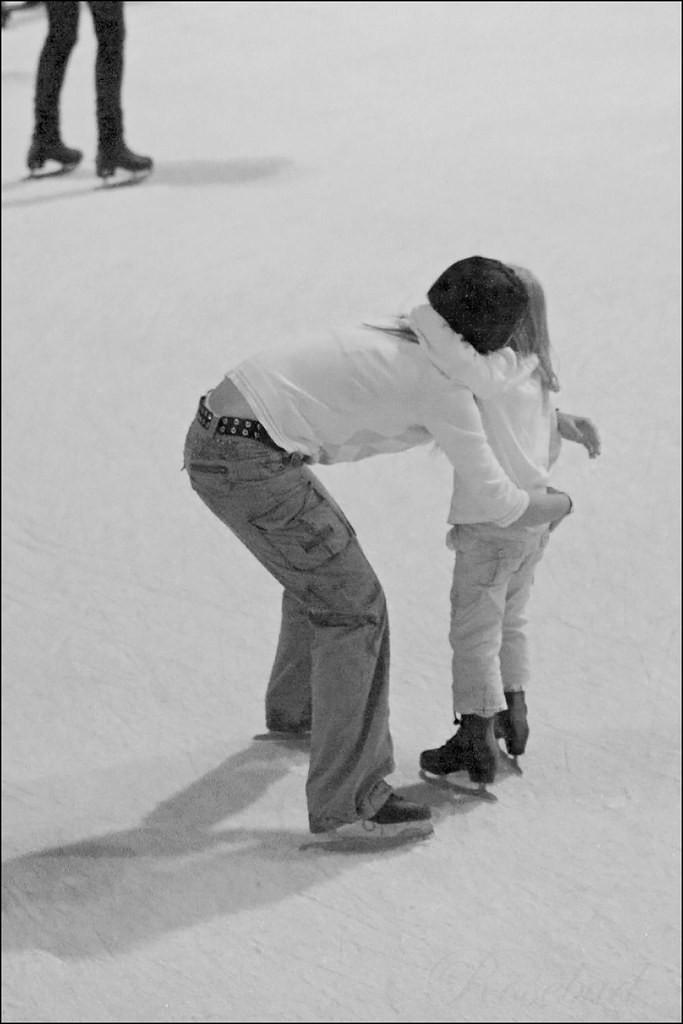
Consciously I had done nothing to promote any such development; on the contrary, my sympathies were on the other side. Something must therefore have been behind the scenes, some intelligence, at any rate something more intelligent than myself. For the extraordinary idea that in the light of consciousness the inner realm of light appears as a gigantic shadow was not something I would have hit on of my own accord.
-- C.G. Jung Memories
Friday, December 4
She held men closely with discovery,
Almost as speed discovers, in the way
Invisible change discovers what is changed,
In the way what was has ceased to be what is.
It was not her look but a knowledge that she had.
She was a self that knew, an inner thing,
Subtler than look's declaiming, although she moved
With a sad splendor, beyond artifice,
Impassioned by the knowledge that she had,
There on the edges of oblivion.
O exhalation, O fling without a sleeve
And motion outward, reddened and resolved
From sight, in the silence that follows her last word–
-- Wallace Stevens, lines from "The Owl in the Sarcophagus"
Read more (link)
Subscribe to:
Comment Feed (RSS)