Visible Mending
5 hours ago
I think of the nightfall all the time.
I think of the dark pine trees
leaning out of the sky
Backlit by diminishing twilight, then not backlit.
I think of the way the tree frogs pitch
And pull in their summer dance.
I think of how the wind comes in from thousands of miles away.
I think of how the darkness abides.
The world's a slick rock we've got to cross,
The air, as Cavalcanti says, tremulous with light
And everywhere nicked with voices and little outcries.
Whose are they, and who are they,
their wings horizon edged,
Their bodies as soft as clouds, their skins tattooed and laid bare and
Graffitied with desolation?
Dreams of them enter, like things alive, the rooms where our loves lie
sleeping.
Listen to what the book says–
Woe to you because of the fire that burns in you, for it is insatiable.
Woe to you because of the wheel that turns in your mind.
This is the way the night comes on,
a narrow and shapeless place,
A few rehearsals among the insects, a few stars,
The thing invisible brought to naught, and back among visible things.
This is the way it all ends.
-- Charles Wright A Short History of the Shadow
Charles Wright

if there are any heavens my mother will (all by herself) have
one. It will not be a pansy heaven nor
a fragile heaven of lilies-of-the-valley but
it will be a heaven of blackred roses
my father will be (deep like a rose
tall like a rose)
standing near my
(swaying over her
silent)
with eyes which are really petals and see
nothing with the face of a poet really which
is a flower and not a face with
hands
which whisper
This is my beloved my
(suddenly in sunlight
he will bow,
& the whole garden will bow)
- E.E. Cummings
When I was a boy I used to think that things progressed by contrasts, that there was a law of contrasts. But this was building the world out of blocks. Afterwards I came to think of the energizing that comes from mere interplay, interaction. Thus, the various faculties of the mind co-exist and interact, and there is as much delight in this mere co-existence as man and woman find in each other's company . . . Cross reflections, modifications, counter-balances, complements, giving and taking are illimitable. They make things inter-dependent and their inter-dependence sustains them and gives them pleasure.
-- Wallace Stevens, 1940 Letter to Hi Simons
And yet the perfect poem can only materialize on condition that this world, acted upon by all five levers [senses] simultaneously, is seen, under a definite aspect, on the supernatural plane, which is, in fact, the plane of the poem . . . But the lover is in such splendid danger just because he must depend on the coordination of his senses, for he knows that they must meet in that unique and risky center in which, renouncing all extension, they come together and have no permanence . . . If the world's whole field of experience, including those spheres which are beyond our knowledge, be represented in a complete circle, it will be immediately evident that when the black sectors, denoting that which we are incapable of experiencing, are measured against the lesser, light sections, correspond to that which is illuminated by the senses, the former are very much greater.
Now the position of the lover is this: that he feels himself unexpectedly placed in the center of the circle, that is to say, at the point where the known and the incomprehensible, coming forcibly together at one single point, become complete and simply a possession, losing thereby, it is true, all individual character . . . As the lover's danger consists in the nonspatial character of his standpoint, so the poet's lies in his awareness of the abysses which divide the one order of sense experience from the other: in truth they are sufficiently wide and engulfing to sweep away from before us the greater part of the world–who knows how many worlds?
-- Rainer Maria Rilke "Primal Sound"
Tr. G. Craig Houston
In the case of the transcendent, the mystery is what promises to unveil itself in the wake of the apocalyptic passing of reality. With the enigma, the self faces its limit, envisions the end of worlds in order to escape their tyranny. Transformation means the rupture of the ordinary domains and patterns of authority, the dense cityscape of doxa that conduct the traffic of thought. Transformation portends the possibility of an alternate self and social order, while enigma preserves a radical open-endedness, vigorously resists perfection in the sense of ontological completion or metaphysical resolution. But in either mystery or enigma, transcendence or transformation, something must die in order for something new to live. Death and rebirth and their dialectic of conflict are the characteristic moments of the human self and the principle features of spirituality and its artistic evocation.
-- David Morgan, from "Secret Wisdom and Self-Effacement: The Spiritual in the Modern Age" Negotiating Rapture: The Power of Art to Transform Lives
The crater's spaces will be filled with starlight. For me, this has a very elegant quality because there are stars that are billions of years old and there is starlight that's fairly recent, maybe only twenty light years old. Other starlight has taken millions or billions of light years to get there. So you can mix this light of different ages, which has a physical presence, which speaks of its time…
-- James Turrell, on Roden Crater, in Parkett 25
James Turrell (link)
Roden Crater (link)
Parkett (link)
I think then no one can admire the beauty of the body more than I do, and it is of course a comfort to find beauty in a friend or a friend in beauty. But this kind of beauty is dangerous. Then comes the beauty of the mind, such as genius, and this is greater than the beauty of the body and not to call dangerous. And more beautiful than the beauty of the mind is the beauty of the character, the "handsome heart."
-- Gerard Manley Hopkins, letter to Robert Bridges, 25 October 1879
Man is his own star; and the soul that can
Render an honest and a perfect man,
Commands all light, all influence, all fate;
Nothing to him falls early or too late.
Our acts our angels are, or good or ill,
Our fatal shadows that walk by us still.
-- Francis Beaumont and John Fletcher The Honest Man's Fortune
The Honest Man's Fortune (link)
Except in a vacuum, silence does not exist. Outside laboratory conditions, perfect sine tones and absolute white noise can't be found. The harmonic series is another elegant conceptual construction that we believe should exist. We hear portions of the harmonic series all the time, in our musical instruments and occasionally in the larger world around us. But we never hear it in full, mathematically pristine form.
The harmonic series, sine tones, white noise, absolute silence: these ideals of sound tantalize the mind's ear. But the world is richer, subtler, more nuanced and more complex than we imagine. Almost nothing we hear conforms to the patterns we construct.
-- John Luther Adams, from "A Composer's Journal, Part II–Studio Notes," February 9, 2005 The Place Where You Go to Listen
We can think about art. We can write and talk and argue about art. We can use art as a vehicle to convey our ideas and our beliefs. But at a certain point, art has to stand on its own. To support real meaning, art must first and foremost be itself.
-- John Luther Adams, from "A Composer's Journal, Part II–Studio Notes," January 30, 2005 The Place Where You Go to Listen
O you tender ones, walk now and then
into the breath that blows coldly past.
Upon your cheeks let it tremble and part;
behind you it will tremble together again.
O you blessed ones, you who are whole,
you who seem the beginning of hearts,
bows for the arrows and arrows' targets–
tear-bright, your lips more eternally smile.
Don't be afraid to suffer; return
that heaviness to the earth's own weight;
heavy are the mountains, heavy are the seas.
Even the small trees you planted as children
have long since become too heavy; you could not
carry them now. But the winds . . . But the spaces . . .
-- Rainer Maria Rilke, from The Sonnets to Orpheus
Tr. Stephen Mitchell
A true noun, an isolated thing, does not exist in nature. Things are only the terminal points, or rather the meeting points, of actions, cross-sections cut through actions, snapshots. Neither can a pure verb, an abstract motion, be possible in nature. The eye sees noun and verb as one : things in motion, motion in things . . .
-- Ernest Fenollosa The Chinese Written Character as a Medium for Poetry
Ed. Ezra Pound
The Chinese Written Character as a Medium for Poetry (link)
Now winter downs the dying of the year,
And night is all a settlement of snow;
From the soft street the rooms of houses show
A gathered light, a shapen atmosphere,
Like frozen-over lakes whose ice is thin
And still allows some stirring down within.
I've known the wind by water banks to shake
The late leaves down, which frozen where they fell
And held in ice as dancers in a spell
Fluttered all winter long into a lake;
Graved on the dark in gestures of descent,
They seemed their own most perfect monument.
There was perfection in the death of ferns
Which laid their fragile cheeks against the stone
A million years. Great mammoths overthrown
Composedly have made their long sojourns,
Like palaces of patience, in the gray
And changeless lands of ice. And at Pompeii
The little dog lay curled and did not rise
But slept the deeper as the ashes rose
And found the people incomplete, and froze
The random hands, the loose unready eyes
Of men expecting yet another sun
To do the shapely thing they had not done.
These sudden ends of time must give us pause.
We fray into the future, rarely wrought
Save in the tapestries of afterthought.
More time, more time. Barrages of applause
Come muffled from a buried radio.
The New-year bells are wrangling with the snow.
-- Richard Wilbur
Richard Wilbur (link)
Bonhoeffer in his skylit cell
bleached by the flares' candescent fall,
pacing out his own citadel,
restores the broken themes of praise,
encourages our borrowed days,
by logic of his sacrifice.
Against the wild reasons of the state
his words are quiet but not too quiet.
We hear too late or not too late.
-- Geoffrey Hill
About Dietrich Bonhoeffer and "Christmas Trees" (link)
Geoffrey Hill (link)
At sundown when a day's words
have gathered at the feet of the trees
lining up in silence
to enter the long corridors
of the roots into which they
pass one by one thinking
that they remember the place
as they feel themselves climbing
away from their only sound
while they are being forgotten
by their bright circumstances
they rise through all of the rings
listening again
afterward as they
listened once and they come
to where the leaves used to live
during their lives but have gone now
and they too take the next step
beyond the reach of meaning
-- W.S. Merwin
W.S. Merwin (link)
… tonight we are privileged to undertake Rachmaninov's "All-Night Vigil." Those of you who have baby sitters who expect you home before dawn may wish to step outside for a few moments to make a phone call. (Lest you be frightened by the title, be apprised that the 15 musical numbers take but 65 minutes in the singing.)
Though written during the early years of World War I (1915), with the restrictions which Rachmaninov imposed upon himself to insure their suitability for liturgical performance, their musical idiom clearly "looks backward" –to the 500-year-old orthodox Znamenny chant as clothed in the loving 19th century language of "the last great representative of Russian Romanticism."
… Ranging from unison voices to eight and twelve parts, and moving from simple chant through variation to improvisation, the Vespers sometimes can be a complex work to put together, but it speaks so directly and simply to the heart, that one of the recurrent difficulties in rehearsal is that we become so emotionally touched–that it is next to impossible to continue singing.
Do not be ashamed if at times your eyes fill with tears (it's good for you)
And it almost certainly is best if we withhold applause until the Vespers are complete. We will not be insulted if even then you do not applaud.
-- Robert Shaw, from "Opening Remarks at Spivey Hall," May 14-15, 1993 The Robert Shaw Reader
All-Night Vigil (link)
Consciously I had done nothing to promote any such development; on the contrary, my sympathies were on the other side. Something must therefore have been behind the scenes, some intelligence, at any rate something more intelligent than myself. For the extraordinary idea that in the light of consciousness the inner realm of light appears as a gigantic shadow was not something I would have hit on of my own accord.
-- C.G. Jung Memories
She held men closely with discovery,
Almost as speed discovers, in the way
Invisible change discovers what is changed,
In the way what was has ceased to be what is.
It was not her look but a knowledge that she had.
She was a self that knew, an inner thing,
Subtler than look's declaiming, although she moved
With a sad splendor, beyond artifice,
Impassioned by the knowledge that she had,
There on the edges of oblivion.
O exhalation, O fling without a sleeve
And motion outward, reddened and resolved
From sight, in the silence that follows her last word–
-- Wallace Stevens, lines from "The Owl in the Sarcophagus"
Read more (link)
That time of year thou mayst in me behold,
When yellow leaves, or none, or few, do hang
Upon those boughs which shake against the cold,
Bare ruined choirs, where late the sweet birds sang.
In me thou see'st the twilight of such day,
As after sunset fadeth in the west,
Which by and by black night doth take away,
Death's second self, that seals up all in rest.
In me thou see'st the glowing of such fire,
That on the ashes of his youth doth lie,
As the death-bed whereon it must expire,
Consumed with that which it was nourished by.
This thou perceiv'st, which makes thy love more strong,
To love that well which thou must leave ere long.
-- William Shakespeare
And then a new light, less dazzling, no doubt, than the other illumination which had made me perceive that the work of art was the sole means of rediscovering Lost Time, shone suddenly within me. And I understood that all the materials for a work of literature were simply my past life; I understood that they had come to me, in frivolous pleasures, in indolence, in tenderness, in unhappiness, and that I had stored them up without divining the purpose for which they were destined or even their continued existence, any more than a seed does when it forms within itself a reserve of all the nutritious substances from which it will feed a plant.
-- Marcel Proust Remembrance of Things Past
Tr. Moncrieff/Kilmartin
Entropy is only found when the parts are viewed in association, and it is by viewing or hearing the parts in association that beauty and melody are discerned.
-- Arthur Eddington The Nature of the Physical World
Arthur Eddington
No doubt my poetry errs on the side of oddness. I hope in time to have a more balanced and Miltonic style. But as air, melody, is what strikes me most of all in music and design in painting, so design, pattern or what I am in the habit of calling 'inscape' is what I above all aim at in poetry.
-- Gerard Manley Hopkins Letter to Robert Bridges 15 February 1879
. . . how hard
it is, to apprehend something so large
in scale and yet so minutely detailed.
Like trying to familiarize yourself,
exactly, with the side of a mountain:
this birch, this rock-pool, this square mosaic
yard of tesserated leaves, autumnal,
a jeweled reliquary. Trying to see
each element of the mountain and then
through them, the whole, since music is only
given to us in time, each phrase parcelled
out, in time.
-- Mark Doty, lines from "Grosse Fuge" Atlantis
Atlantis
Underneath the water, or inside it, is a dark grey flame:
I have seen it over and over, the same sea, the same,
slightly, indifferently swinging above the stones,
icily free above the stones,
above the stones and then the world.
If you should dip your hand in,
you wrist would ache immediately,
your bones would begin to ache and your hand would burn
as if the water were a transmutation of fire
that feeds on stones and burns with a dark gray flame.
-- Elizabeth Bishop, lines from "At the Fishhouses"
At the Fishhouses (poem and commentary by George Szirtes) (link)
These are then two arts which enclose man in man; or, rather, which enclose the being in its work, and the soul in its acts and in the production of its acts, as our former body was entirely encased in the creations of its eye, and surrounded with sight. By means of two arts it wraps itself up, in two different ways, in their inner laws and wills, which are figured forth in one material or another, stone or air.
-- Paul Valéry Eupolinos
Tr. Denise Folliot
Swimming through the oval, saucer-like reflections, dipping and flashing on the sea surface, one traced the colors back to the origins of those reflections. Some came directly from the sky and different colored clouds, some from the golden greens of the vegetation growing on the cliffs, some from the red-orange of the seaweed on the blues and violets of the adjacent rocks, and, all between, the actual hues of the water, according to its various depths and over what it was passing. The entire elusive, unstable, flicking complex subject to the changing qualities of the light itself . . . it was as though one was swimming through a diamond.
-- Bridget Riley The Eye's Mind
Bridget Riley (link)
How are you, Robert? BRIGHTER STILL EARTHBOUND
I ASK : NO ACCIDENT? & GET WHITE SOUND
A BLUR EACH MOMENT CLOSER TO SOME CLEAR
SONG OF BLISS : ONE OF THE MARVELS HERE.
ANOTHER IS TO TALK TO THAT WORD'S NAMESAKE.
Andrew? THE VERY SAME DO I CALL HIM ANDY?
I called you Andrew in "The Summer People".
AH THEN I CAN PRACTISE IN THE GLASS
What does he say in Heaven? Can you quote?
The cup, with a mimed clearing of its throat,
Enunciates : 'WHAT'S WRONG WITH EMPIRES PRAY?
GREATLY BENEFICIAL. FOR THE SUBJECTED,
DELICIOUS SUBJUGATION & FOR THE RULERS,
TERRIBLE FEARS OF LOSING, BALANCED BY
RARE OPPORTUNITIES FOR BEASTLINESS'
Anything about poetry? EVERYTHING!
I DRINK IT IN : 'THE LINE, MY DEAR NEW FRIEND,
THE LINE! LET IT RUN TAUT & FLEXIBLE
BETWEEN THE TWO POLES OF RHYTHM & RHYME,
& WHAT YOU HANG ON IT MAY BE AS DULL
OR AS PROVOCATIVE AS LAUNDRY.' How does
New work get round in Heaven? WE ADEPT READERS
MERELY CALL TO MIND THE MOLECULAR PAGE
PLUS A LIVING KNOWN OR UNKNOWN AUTHOR
& THINK 'NEW POEM PLEASE' & PRESTO ! EITHER
SOME SHAGGY DOGGEREL FROM THE COAST APPEARS
OR A SPARKLER FROM ACADEME. SAME PRINCIPLE
EXACTLY WHEREBY WE POP UP WITHIN YR
FIELD OF REFLECTION AS U THINK OF US
THEN FLASH BACK TO OUR BLIND WORK IN THE VOID
WHEN YR ATTENTION DIES
-- James Merrill, from The Changing Light at Sandover
About The Changing Light at Sandover (link)
The great light cage has broken up in the air,
freeing, I think, about a million birds
whose wild ascending shadows will not be back,
and all the wires come falling down.
No cage, no frightening birds; the rain
is brightening now. The face is pale
that tried the puzzle of their prison
and solved it with an unexpected kiss,
whose freckled unsuspected hands alit.
-- Elizabeth Bishop
And some time make the time to drive out west
Into County Clare, along the Flaggy Shore,
In September or October, when the wind
And the light are working off each other
So that the ocean on one side is wild
With foam and glitter, and inland among stones
The surface of a slate-grey lake is lit
By the earthed lightning of a flock of swans,
Their feathers roughed and ruffling, white on white,
Their fully grown headstrong-looking heads
Tucked or cresting or busy underwater.
Useless to think you'll park and capture it
More thoroughly. You are neither here nor there,
A hurry through which known and strange things pass
As big soft buffetings come at the car sideways
And catch the heart off guard and blow it open.
-- Seamus Heaney, from The Spirit Level
Just once I knew what life was for.
In Boston, quite suddenly, I understood;
walked there along the Charles River,
watched the lights copying themselves,
all neoned and strobe-hearted, opening
their mouths as wide as opera singers;
counted the stars, my little campaigners,
my scar daisies, and knew that I walked my love
on the night green side of it and cried
my heart to the eastbound cars and cried
my heart to the westbound cars and took
my truth across a small humped bridge
and hurried my truth, the charm of it, home
and hoarded these constants into morning
only to find them gone.
-- Anne Sexton, from love poems
Often, our experience of beauty will be the first hint of what each of us at some point will dare call our soul. For don’t those first stirrings of that eternally uncertain, barely grasped notion of something more than mere mind, mere thought, mere emotion, usually first come to us in the line of a poem, a passage of music, of the unreal yet more-than-real image in a painting?
-- C.K. Williams, in "All Around the World the Same Song" Poetry March 2009
Read more
La Nature est un temple où de vivants piliers
Laissent parfois sortir de confuses paroles;
L’homme y passe à travers des forêts de symboles
Qui l’observent avec des regards familiers.
Nature is a temple whose living pillars
Sometimes give forth a babel of words;
Man wends his way through forests of symbols
Which look at him with their familiar glances.
Comme de longs échos qui de loin se confondent
Dans une ténébreuse et profonde unité,
Vaste comme la nuit et comme la clarté,
Les parfums, les couleurs et les sons se répondent.
As long-resounding echoes from afar
Are mingling in a deep, dark unity,
Vast as the night or as the orb of day,
Perfumes, colors, and sounds commingle.
-- Charles Baudelaire, lines from "Correspondances"
Tr. Harry Zohn
He sang the brightness of mornings and green rivers,
He sang of smoking water in the rose-colored daybreaks,
Of colors: cinnabar, carmine, burnt sienna, blue,
Of the delight of swimming in the sea under marble cliffs,
Of feasting on a terrace above the tumult of a fishing port,
Of the tastes of wine, olive oil, almonds, mustard, salt.
Of the flight of the swallow, the falcon,
Of a dignified flock of pelicans above a bay,
Of the scent of an armful of lilacs in summer rain,
Of his having composed his words always against death
And of having made no rhyme in praise of nothingness.
-- Czeslaw Milosz, lines from "Orpheus and Eurydice" second space
And builds, within, a tower that is not stone
(Not stone can jacket heaven)–but slip
Of pebbles,–visible wings of silence sown
In azure circles, widening as they dip
-- Hart Crane, lines from "The Broken Tower"
The Broken Tower
Any time. Now. The next minute.
Years from today. You lean forward
and wait. You relax, but you don't forget.
Someone plans an elaborate party
with a banquet, dancing, even fireworks
when feasting is over. You look at them:–
All those years when you searched the world
like a ferret, these never happened–your marriage,
your family, prayers, curses. Only dreams.
A vacuum has opened everywhere. Cities,
armies, those chairs ranked in the great
hall for the audience–there isn't anyone.
Like a shutter the sky opens and closes
and the show is over. The next act
will deny that anything ever happened.
Your hand falls open. It is empty. It never
held a knife, a flower, gold,
or love, or now. Lean closer–
Listen to me: there isn't any hand.
-- William Stafford, from The Answers Are Inside the Mountains
A poet of Shakespeare's time was apt to say that his love for his beloved was not "sublunar." He meant that his affection was like the stars–constant and unchanging. According to the philosophy that prevailed in Shakespeare's time, change occurred only below the Moon, in our terrestrial world of jumbled elements and inconstant emotions. By contrast, the celestial realm above the Moon, like the poet's love, was fixed and eternal. Or so people believed. And then, to the consternation of poets and philosophers, in the autumn of 1572 a new star blazed in the constellation Cassiopeia. The star was well placed for viewing, high overhead in the evening sky. It was brighter than any other star, bright enough to be seen in broad daylight. All Europe was agog. But was this new star really above the Moon, in which case philosophers were wrong and the heavens do change?
. . . On the evening of November 11, 1572, Tycho was walking home to supper when he happened to glance up at the stars above his head. He saw the new star at once, the nova stella. Afraid to believe his own eyes, he asked his servants and neighbors to look into the sky and describe what they saw. They confirmed his observation. The star was real. Tycho was a talented astronomer, and he had recently built a fine new instrument (not a telescope; that device was still a few decades away) for determining the positions of stars. Carefully, he measured the angular separation of the new star from the stars of Cassiopeia. He continued these observations at different times of the night and throughout the winter as the star slowly faded. He also collected measured positions of the new star from other European observers. He was trying to determine the star's parallax, the apparent change in the position of an object when viewed from two different places . . . The object in Cassiopeia did not shift at all against the background stars when viewed from different places. From these observations Tycho knew that the new star was in the highest heavens, far beyond the Moon. The philosophers were wrong; the heavens do change.
-- Chet Raymo An Intimate Look at the Night Sky
Tycho Brahe (a father of modern astronomy)
As he walked down a street in Baltimore, Oliver passed the shop of a stonemason. There was a little yard around the shop powdered with stonedust. In the yard were scattered pieces of stone, blocks of grey Vermont granite, Georgia marble, and several bases of sandstone. There was also a monument from Carrarra in Italy: it was of a marble angel, with bright carved wings. The angel held a lily delicately upwards between its cold elegant fingers.
Oliver walked on, returned, and peered through the dirty windows of the little shop. Within he saw smooth marble slabs of death, a stone lamb couchant on a granite marker, a cherub volant on a plump foot, a scrollwork, and two joined armless hands. He also saw two more angels with simpering marble faces, and furled wings.
A bearded brawny man wearing a work apron was standing in the yard above a wooden trestle. He held a great wooden mallet and a chisel in his hands and he was chipping with tense craft at a design that had been penciled upon the surface of a marble slab.
As Oliver looked at the man and the big angel with its carved stipe of lilystalk, a cold and nameless excitement possessed him. The long fingers of his big hands curled. He felt that he wanted to carve delicately with a chisel more than anything in the world. He wanted to wreak something dark and unspeakable in him into cold stone. He wanted to carve an angel's head.
Oliver entered the yard and asked the man for a job. The man put down his mallet and looked at him.
"Son," he said kindly, "it is hard work and I can not pay you much while you learn."
"I don't care," said Oliver. "I want to learn the business."
He became the stonecutter's apprentice. He worked in that dusty yard for five years. He became a stonecutter. When his apprenticeship was over, he had become a man.
-- Thomas Wolfe O Lost
Stacks of books, every page, characters’
rages and poets’ strange contraptions
of syntax and song, every song
even when there isn’t one.
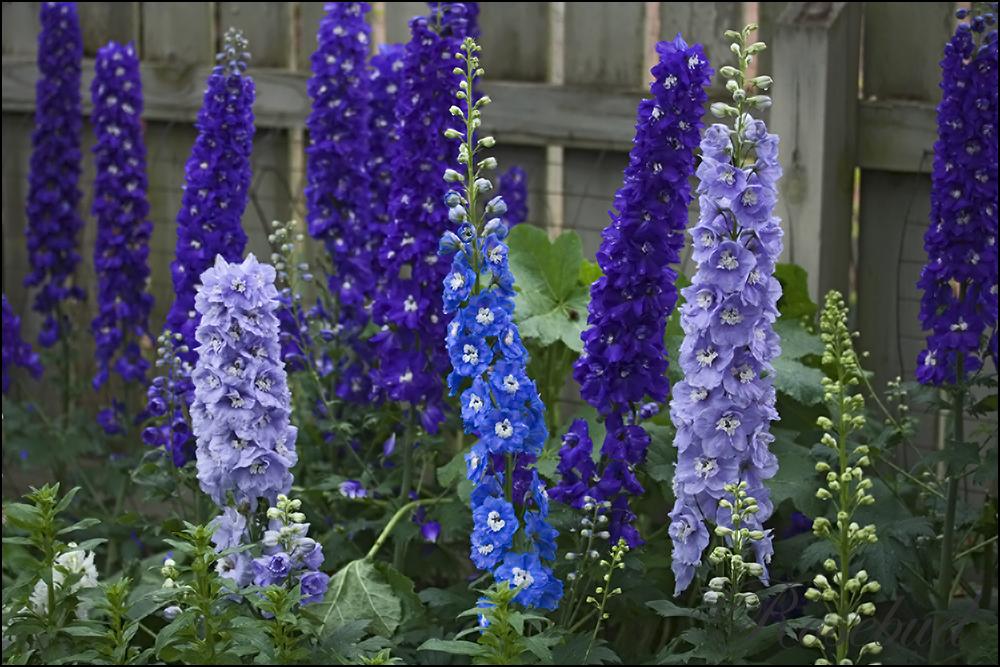
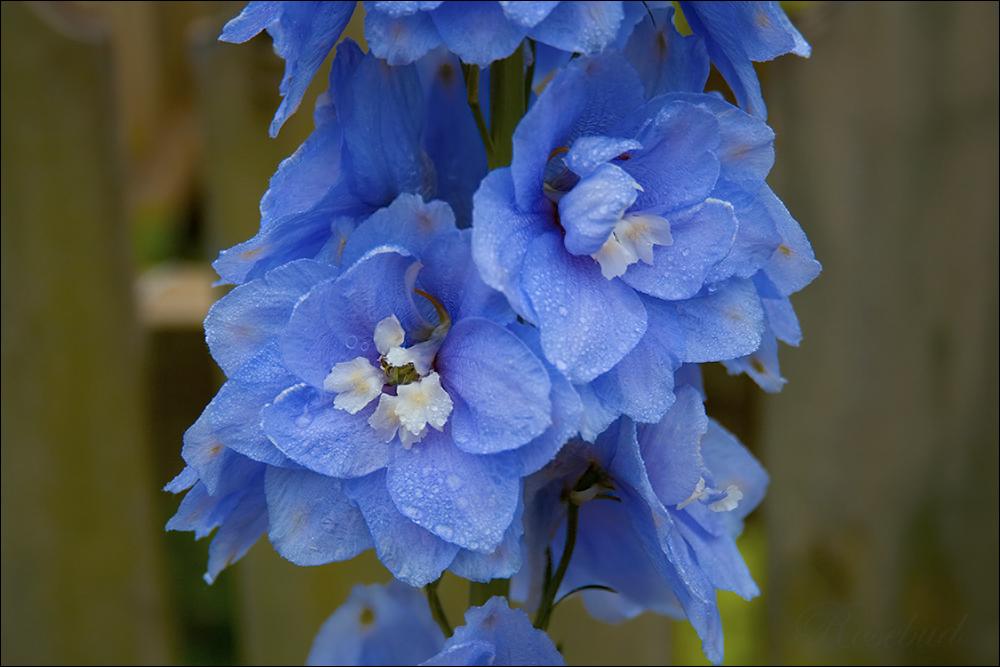
-- Dean Young, lines from "Delphiniums in a Window Box"
Delphiniums in a Window Box
For how many years have you gone through the house shutting the windows,
while the rain was still five miles away
and veering, o plum-colored clouds, to the north,
away from you
and you did not even know enough
to be sorry,
you were glad
those silver sheets, with the occasional golden staple,
were sweeping on, elsewhere,
violent and electric and uncontrollable--
and will you find yourself finally wanting to forget
all enclosures, including
the enclosure of yourself, o lonely leaf, and will you
dash finally, frantically,
to the windows and haul them open and lean out
to the dark, silvered sky, to everything
that is beyond capture, shouting
I'm here, I'm here! Now, now, now, now, now.
-- Mary Oliver, lines from "From the Book of Time"
The leaves and branches moved, green on darker green, shadow on shadow, rising right up to the clear blue sky. A thick rustling of foliage which sighed as the cool breeze moved through it, but somehow confirmed its density, the secrecy that surrounded its branches, its lush growth. It cut out much of the morning sun, so that small lozenges of yellow light fell on the footpath, but only for a while, then light and shadow would move and disperse as the shadow branches wavering on the ground sent shadow leaves moving, and with it, the sound of air sighing in a little rush of sound, the small shapes of bright light moved also.
-- Eva Figes Light
Each artist embarks on a personal search.
An artist may take introspective refreshment from green.
Or so they say in Barcelona when air is dry.
In our country it is a water sprinkler that hints, "rinsed green."
Colors often break themselves into separate hues
of noisetone. In a Barcelona cabaret when green is overtaken,
it is stirred into the mint color of drink.
The spirit is lifted among primary colors. Nine rows of color.
The future writ in white spaces.
-- Barbara Guest
The Collected Poems of Barbara Guest
a medley of scattered fragments—one so calm and shy, almost detached and as if philosophical, the other so urgent, anxious, imploring—were nevertheless the same prayer, bursting forth like different inner sunrises, and merely refracted through the different mediums of other thoughts, of artistic researches carried on through the years in which he had sought to create something new. A prayer, a hope which was at heart the same, distinguishable beneath these disguises in the various works of Viteuil.
-- Marcel Proust In Search of Lost Time
Tr. Moncrieff/Kilmartin/Enright
Caught out in daylight, a rabbit's
transparent pallor, the moon
is paired with a cloud of equal weight:
the heavenly congruence startles.
For what is the moon, that it haunts us,
this impudent companion immigrated
from the system's less fortunate margins,
the realm of dust collected in orbs?
We grow up as children with it, a nursemaid
of a bonneted sort, round-faced and kind,
not burning too close like parents, or too far
to spare even a glance, like movie stars.
No star but in the zodiac of stars,
a stranger there, too big, it begs for love
(the man in it) and yet is diaphanous,
its thereness as mysterious as ours.
-- John Updike
Listen to a reading of this poem by Charles McGrath (link)
A virginity which, in its solitude, faced with the transparency of a commensurate gaze, has itself been as it were fragmented into its component whitenesses, one upon the next, the wedding — proofs of the Idea.
-- Stephane Mallarmé "Mystery in Literature"
Tr. Mary Ann Caws
Mallarmé in Prose
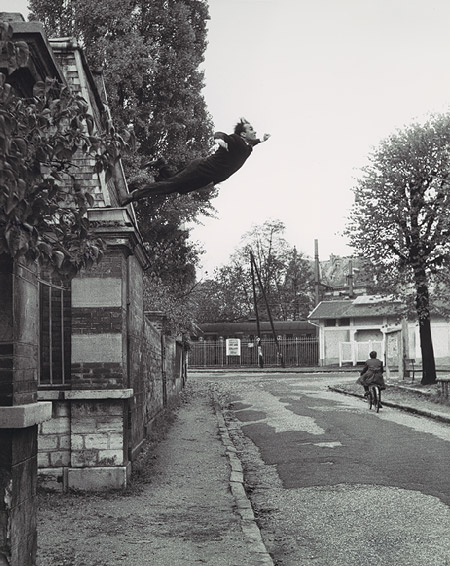
Saut dans le vide (Leap into the Void) by Yves Klein, Harry Shrunk, John Kender 1960 (link)
The soul has that measureless pride which consists in never acknowledging any lessons but its own. But it has sympathy as measureless as its pride and the one balances the other and neither can stretch too far while it stretches in company with the other. The inmost secrets of art sleep with the twain.
-- Walt Whitman, preface Leaves of Grass 1855
as light that can never
see itself
as none can lie still
falling free
I see your eyes
see
-- Inger Christensen, lines from it
Tr. Susanna Nied
Inger Christensen