Visible Mending
5 hours ago
You who never arrived
in my arms, Beloved, who were lost
from the start,
I don't even know what songs
would please you. I have given up trying
to recognize you in the surging wave of the next
moment. All the immense
images in me—the far-off, deeply-felt landscape,
cities, towers, and bridges, and un-
suspected turns in the path,
and those powerful lands that were once
pulsing with the life of the gods—
all rise within me to mean
you, who forever elude me.
You, Beloved, who are all
the gardens I have ever gazed at,
longing. An open window
in a country house—, and you almost
stepped out, pensive, to meet me. Streets that I chanced upon,—
you had just walked down them and vanished.
And sometimes, in a shop, the mirrors
were still dizzy with your presence and, startled, gave back
my too-sudden image. Who knows? perhaps the same
bird echoed through both of us
yesterday, separate, in the evening . . .
-- Rainer Maria Rilke
Translated by Stephen Mitchell

For, as on the coloured canvas
Subtle pencils softly blend
Dark and light in such proportions
That the dim perspectives end --
Now perhaps like famous cities,
Now like caves or misty capes,
For remoteness ever formeth
Monstrous or unreal shapes . . .
So it was, while I alone,
Saw their bulk and vast proportions
But their form remained unknown.
First they seemed to us uplifting
High in heaven their pointed towers,
Clouds that to the sea descended,
To conceive in sapphire showers
What they would bring forth in crystal.
And this fancy seemed more true,
As from their untold abundance
They, methought, could drink the blue
Drop by drop. Again sea monsters
Seemed to us the wandering droves,
Which, to form the train of Neptune,
Issued from their green alcoves.
For the sails, when lightly shaken,
Fanned by zephyrs as by slaves,
Seemed to us like outspread pinions
Fluttering o'er the darkened waves;
Then the mass, approaching nearer,
Seemed a mighty Babylon,
With its hanging gardens pictured
By the streamers fluttering down.
But at last our certain vision
Undeceived, becoming true,
Showed it was a great armada
For I saw the prows cut through
Foam . . .
-- Pedro Calderón de la Barca The Constant Prince
Translated by Denis Florence McCarthy
I see in painters prose writers and poets. Rhyme, measure, the turning of verses which is indispensable and which gives them so much vigor, are analogous to the hidden symmetry, to the equilibrium at once wise and inspired, which governs the meeting or separation of lines and spaces, the echoes of color, etc . . . But the beauty of verse does not consist of exactitude in obeying rules, when even the most ignorant eyes see at once any lack of attention to them. It resides in a thousand secret harmonies and conventions which make up the power of poetry and which go straight to the imagination; in just the same way the happy choice of forms and the right understanding of their relationship act on the imagination in the art of painting.
-- Eugène Delacroix, 19 September 1847 The Journal of Eugène Delacroix
Translated by Walter Pach
Early in the morning or on my days off, I sit in the empty auditorium, gazing at the stage. I am envisioning a variation from my repertoire, imagining, in detail, first how I will look in costume, then how I will enter the stage and from which wing. As if watching a movie, I then dance the variation in my mind the very best that I can, or even better -- the leaps a foot higher, the space covered double what I have done in the past. I picture the expression on my face, the use of my arms and hands, and the speed at which I move. A dream of the possible, glorified, runs on an imaginary loop through my mind, sometimes in slow motion, sometimes accelerated.
At first, I run this imaginary film to rhythmic counting alone (without music, melody, theme, harmony, etc.) -- creating a blueprint of mathematical time. For example, I launch into a leap on the first count (or beat), float through the second and third counts, and land noiselessly on the fourth. Next, I rerun these movements, adding, in my head, the melody of the music in place of the counts. Each of these processes I repeat multiple times.
Now I am ready to make the imagined concrete. Up on the stage, I rehearse what I have envisioned -- step by step, count by count, without music, over and over again. Sometimes I spend as much as two hours on a dance sequence that is perhaps one-and-a-half minutes long. During these repetitions, I count the beats out loud as I dance, even rehearsing how I will breathe. I also practice the dance movements in three different tempos : slow motion, ideal, and accelerated (in case the orchestra conductor has an adrenaline rush during the performance). I am now prepared to handle any tempo that may emanate from the orchestra pit.
To end my practice session, I dance the entire variation, singing the melody as though it were an aria. Sometimes as I dance, I speak out loud to an imaginary audience. I comment on what I am doing and sell it to them: "Watch this! Did you like that? Here comes the biggest leap!"
-- Jacques d'Amboise, from "The mind in dance" Dædalus Summer 2006
The Dancing Hiker
Our intellect is not the most subtle, the most powerful, the most appropriate, instrument for revealing the truth. It is life that, little by little, example by example, permits us to see that what is most important to our heart, or to our mind, is learned not by reasoning but through other agencies. Then it is that the intellect, observing their superiority, abdicates its control to them upon reasoned grounds and agrees to become their collaborator and lackey.
-- Marcel Proust, quoted in Memorable Quotations: Jewish Writers of the Past by Carol A. Dingle
More Proust quotations from this book
And writing laughs and says, 'you know my secret. In truth, I can only write of the day in the ink of night; I bring the day only by way of deep oblivion. Somewhere else, another day is rising, a brighter sun. Somewhere else is rising the day to which all days are mere indices. How to write of the day itself, free from night? How to write in white ink on a white page, or in darkness upon darkness?
'I know this is your dream, time, which is why you look for me.'
via Spurious
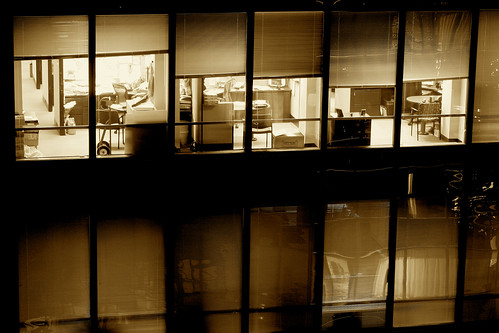
There's nothing worse
than feeling bad and not
being able to tell you.
Not because you'd kill me
or it would kill you, or
we don't love each other.
It's space. The sky is grey
and clear, with pink and
blue shadows under each cloud.
A tiny airliner drops its
specks over the UN Building.
My eyes, like millions of
glassy squares, merely reflect.
Everything sees through me,
in the daytime I'm too hot
and at night I freeze; I'm
built the wrong way for the
river and a mild gale would
break every fiber in me.
Why don't I go east and west
instead of north and south?
It's the architect's fault.
And in a few years I'll be
useless, not even an office
building. Because you have
no telephone, and live so
far away; the Pepsi-Cola sign,
the seagulls and the noise.
-- Frank O'Hara
Light the first light of evening
In which we rest and, for small reason, think
The world imagined is the ultimate good.
This is, therefore, the intensest rendezvous.
It is in that thought that we collect ourselves,
Out of all the indifferences, into one thing:
Within a single thing, a single shawl
Wrapped tightly round us, since we are poor, a warmth,
A light, a power, the miraculous influence.
Here, now, we forget each other and ourselves.
We feel the obscurity of an order, a whole,
A knowledge, that which arranged the rendezvous.
Within its vital boundary, in the mind.
We say God and the imagination are one...
How high that highest candle lights the dark.
Out of this same light, out of the central mind,
We make a dwelling in the evening air,
In which being there together is enough.
-- Wallace Stevens
"What was most difficult for you as a student?" I asked one evening after what had been billed as an informal chat with the conducting seminar students had grown into a monologue before an audience of about a hundred and he had momentarily run out of steam.
"Oh, controlling myself," he said without hesitation. He was sitting on the floor in his blue jeans and cowboy boots, his shirt unbuttoned to expose a tanned white-haired chest and a protruding pot belly. "So as not to fall into a fainting fit in the middle of the finale. The second week I was here, in 1940, I was doing Scheherazade, and in the middle of it, I remember having something like a heart attack. That was a big lesson to me. You are there to serve the music and you have to take care of yourself. There's a certain point beyond which you cannot let yourself go.
"I still haven't learned that lesson completely. I still go haywire and walk off the stage after a Tchaikovsky symphony so that they have to throw buckets of water at me. But the advice I have to give has to do with not going overboard. Your ideal situation is the complete loss of ego."
He paused, examining the young faces around him.
"I don't know whether any of you have experienced that but it's what everyone in the world is always searching for. When it happens in conducting, it happens because you identify so completely with the composer, you've studied him so intently, that it's as though you've written the piece yourself. You completely forget who you are or where you are and you write the piece right there. You just make it up as though you never heard it before. Because you have become that composer.
"I always know when such a thing has happened because it takes me so long to come back. It takes four or five minutes to know what city I'm in, who the orchestra is, who are the people making all that noise behind me, who am I? It's a very great experience and it doesn't happen often enough. Ideally it should happen every time, but it happens about as often in conducting as in any other department where you lose ego. Schopenhauer said that music was the only art in which this could happen and that art was the only area of life in which it could happen. Schopenhauer was wrong. It can happen in religious ecstasy or meditation. It can happen in orgasm when you are with someone you love."
The students received all this in silence. Then someone in the back of the room raised his hand.
"How do you train yourself to lose your ego?"
Bernstein lit another in his chain of cigarettes and regarded him politely. "If you have to train yourself to do that, I don't think you're in the right business. If you are an artist, you are a driven person. My father didn't want me to be a musician but he couldn't win. It was destiny. I didn't care what it cost me. My father wouldn't give me money for lessons and I had to go out and play in jazz bands at the age of twelve. But it was in the stars. If you have to try to concentrate, you should be in the shoe business.
"That doesn't mean you don't have your doubts every now and then," he said, more gently. "I don't know any great musician who has not had the experience of wondering whether he shouldn't have been doing something else and then saying, 'Of course not!' It's like love. What was Plato's definition of love? You desire the happiness of the beloved. You desire the best for the music. What you are interested in is the well-being of the object you love."
-- Leonard Bernstein, quoted in Music Talks by Helen Epstein
Welcome, O life! I go to encounter for the millionth time the reality of experience and to forge in the smithy of my soul the uncreated conscience of my race.
-- James Joyce (b. 2 Feb 1882) A Portrait of the Artist as a Young Man
The Brazen Head: A James Joyce Public House
As he takes his hat off; as he lifts his head
like if right now he could be any animal he'd
choose coyote; as all the usual sunset colors
break over his face,
he starts up singing again,
same as every night, same song: loneliness
by starlight, miles to go, lay me down by
the cool, etc. — that kind of song, the kind
you'll have heard before, sure, somewhere,
but where was that,
the singer turning this
and that way, as if watching the song itself
— the words to the song — leave him, as he
lets each go, the wind carrying most of it,
some of the words, falling, settling into
instead that larger darkness, where the smaller
darknesses that our lives were lie softly down.
-- Carl Phillips, from "Riding Westward"
this poem
Carl Phillips
Nothing in itself, beauty may be a mental solvent that dissolves something else, melting it into radiance.
-- Peter Schjeldahl, quoted by David Maisel in a conversation with Jörg Colberg here
You are the blessing in a stride toward perdition,
When living sickens more than sickness does itself;
The root of beauty is audacity,
And that is what draws us to each other
-- Boris Pasternak Doctor Zhivago
Translated by Max Hayward and Manya Harari
I saw the sculpture: a wiry, thin person, long legs in full stride, thrust his small, mute head forward into the empty air. Six feet tall, bronze . . .
I saw a stilled figure in a swirl of invisible motion. I saw a touchy man moving through a still void. Here was the thinker in the world--but there was no world, only the abyss through which he walked. Man Walking was pure consciousness made poignant: a soul without a culture, absolutely alone, without even a time, without people, speech, books, tools, work, or even clothes. He knew he was walking, here. He knew he was feeling himself walk; he knew he was walking fast and thinking slowly, not forming conclusions, not looking for anything. He himself was barely there. He was in spirit and in form a dissected nerve. He looked freshly made of clay by God, visibly pinched by sure fingertips . . .
I drew Man Walking in his normal stalking pose and, later, dancing with his arms in the air. What if I fell in love with a man, and he took off his shirt, and I saw he was Man Walking, made of bronze, with Giacometti's thumbprints on him? Well then, I would love him more, for I knew him well; I would hold, if he let me, his twisty head.
-- Annie Dillard An American Childhood
Giacometti's Walking Man II
Myth makes Echo the subject of longing and desire. Physics makes Echo the subject of distance and design. ... And where there is no Echo there is no description of space or love.
There is only silence.
-- Mark Danielewski House of Leaves
via delanceyplace
The wind is light and smells of summer rain.
He lies beneath his years, adrift in light,
cooled by wind. The morphine taken for pain
has left him in a pillowed daze. Where night
is caught by day, where light and shadow catch
as wind ruffles cedar and sugar pine,
he thinks he hears rain. In a tear-drop patch
of light across his chest he can count nine
faces he remembers. Then it turns dark
and the faces catch like tufts of cotton
on the ragged fence of his toes. They mark
his body's end. Now he has forgotten
everything but the smell of summer rain
mingled with cedar and sugar pine. Light
it seems can be borne on wind the way pain
can be borne on breath, or a trace of night
on noon's brilliant shimmer. The wind is light.
The wind is summer rain, the breath of years,
a face transformed to memory. The night
has come at last to wash away his tears.
Gone now, leaving only light. Gone, as pain
is gone, and time, and then the sound of rain.
-- Floyd Skloot, from The End of Dreams
Floyd Skloot website
The true content of a photograph is invisible, for it derives from a play, not with form, but with time. One might argue that photography is as close to music as to painting. I have said that a photograph bears witness to a human choice being exercised. This choice is not between photographing x and y: but between photographing at x moment or at y moment. The objects recorded in any photograph (from the most effective to the most commonplace) carry approximately the same weight, the same conviction. What varies is the intensity with which we are made aware of the poles of absence and presence. Between these two poles photography finds its proper meaning. (The most popular use of the photograph is as a memento of the absent.)
-- John Berger The Look of Things
Whenever I walk, my body is interrelated with the world in which and on which I take my steps. This presupposes some harmony between body and world. We know from physics that the earth rises infinitesimally to meet my step, as any two bodies attract each other. The balance essential in walking is one that is not solely in my body; it can be understood only as a relationship of my body to the ground on which it stands and walks. The earth is there to meet each foot as it falls, and the rhythm of my walking depends on my faith that the earth will be there.
-- Rollo May The Courage to Create
I was learning the fugue when suddenly a vacuum cleaner started up beside the piano. Well, the result was that in the louder passages, this luminously diatonic music in which Mozart deliberately imitates the technique of Sebastian Bach became surrounded with a halo of vibrato, rather the effect you might get if you sang in the bathtub with both ears full of water and shook your head from side to side all at once. And in the softer passages I couldn't hear any sound that I was making at all. I could feel, of course -- I could sense the tactile relation with the keyboard which is replete with its own kind of acoustical associations -- and I could imagine what I was doing, but I couldn't actually hear it. But the strange thing was that all of it suddenly sounded better than it had without the vacuum cleaner, and those parts which I couldn't actually hear sounded best of all. Well, for years thereafter, and still today, if I am in a great hurry to acquire an imprint of some new score on my mind, I simulate the effect of the vacuum cleaner by placing some totally contrary noises as close to the instrument as I can. It doesn't matter what noise, really -- TV westerns, Beatles records; anything loud will suffice -- because what I managed to learn through the accidental coming together of Mozart and the vacuum cleaner was that the inner ear of the imagination is very much more powerful a stimulant than is any amount of outward observation.
-- Glenn Gould, quoted in "Vacuum Cleaner as Continuo" (included in liner notes for this CD
Translated by Gery Bramall
So long as you write what you wish to write, that is all that matters; and whether it matters for ages or only for hours, nobody can say. But to sacrifice a hair of the head of your vision, a shade of its colour, in deference to some Headmaster with a silver pot in his hand or to some professor with a measuring-rod up his sleeve, is the most abject treachery.
-- Virginia Woolf A Room of One's Own
more
happy birthday virginia!
It is not so much that we are going back in time as that time seems circular, and past and future have lost meaning. I understand much better now Einstein's remark that the only real time is that of the observer, who carries with him his own time and space. In these mountains, we have fallen behind history.
-- Peter Matthiessen The Snow Leopard
On the side of the slope, angels revolving
Their dresses of wool, in fields of emerald and steel.
Flames shoot out of meadows, to the top of the hill.
To the left, the face of the ascent is pitted
By all homicides and every battle,
And the sounds of disaster string out on a curve.
Behind the ascent on the right, the orient line of progression.
And while this band in the distance
Is made of the whirling, leaping sounds
Of conch shells and human nights,
The flowery softness of the stars and all the sky
Flows over the side of the slope
Like a basket poured out in our face,
And turns the abyss beneath us a flowering blue.
-- Arthur Rimbaud
Translated by Paul Schmidt
original here
A picture is something that makes invisible its before and after.
-- Jeff Wall
A conversation with Jeff Wall
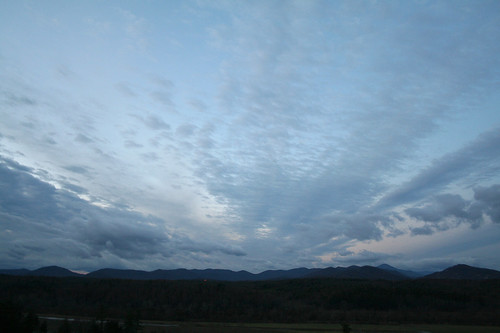
after rain, it's dawn at the edge of the world-- look up! and walk the sky with me
"There you are!" he cried at her, half angrily. "Your words are empty to me. There is nothing clear and sharp and definite about the thought you have expressed. You cannot pick it up in your two hands and look at it. In point of fact, it is not a thought. It is a feeling, a sentiment, a something based upon illusion and not a product of the intellect at all."
As he went on his voice again grew soft, and a confiding note came into it. "Do you know, I sometimes catch myself wishing that I, too, were blind to the facts of life and only knew its fancies and illusions. They're wrong, all wrong, of course, and contrary to reason; but in the face of them my reason tells me, wrong and most wrong, that to dream and live illusions gives greater delight. And after all, delight is the wage for living. Without delight, living is a worthless act. To labor at living and be unpaid is worse than to be dead. He who delights the most lives the most, and your dreams and unrealities are less disturbing to you and more gratifying than are my facts to me."
He shook his head slowly, pondering.
"I often doubt, I often doubt, the worthwhileness of reason. Dreams must be more substantial and satisfying. Emotional delight is more filling and lasting than intellectual delight; and besides, you pay for your moments of intellectual delight by having the blues. Emotional delight is followed by no more than jaded senses which speedily recuperate. I envy you, I envy you."
He stopped abruptly, and then on his lips formed one of his strange quizzical smiles, as he added:
"It's from my brain I envy you, take notice, and not from my heart. My reason dictates it. The envy is an intellectual product. I am like a sober man looking upon drunken men, and, greatly weary, wishing he, too, were drunk."
"Or like a wise man looking upon fools and wishing he, too, were a fool," I laughed.
"Quite so," he said. "You are a blessed, bankrupt pair of fools. You have no facts in your pocketbook."
"Yet we spend as freely as you," was Maud Brewster's contribution.
"More freely, because it costs you nothing."
"And because we draw upon eternity," she retorted.
"Whether you do or think you do, it's the same thing. You spend what you haven't got, and in return you get greater value from spending what you haven't got than I get from spending what I have got, and what I have sweated to get."
"Why don't you change the basis of your coinage, then?" she queried teasingly.
He looked at her quickly, half-hopefully, and said, all regretfully: "Too late. I'd like to, perhaps, but I can't. My pocketbook is stuffed with the old coinage, and it's a stubborn thing. I can never bring myself to recognize anything else as valid."
He ceased speaking, and his gaze wandered absently past her and became lost in the placid sea. The old primal melancholy was strong upon him. He was quivering to it. He had reasoned himself into a spell of the blues, and within few hours one could look for the devil within him to be up and stirring. I remembered Charley Furuseth, and knew this man's sadness as the penalty which the materialist ever pays for his materialism.
-- Jack London The Sea Wolf
I began to catch glimpses of mysterious depths. Boundaries of separate objects lifted and opened, the land seemed charged with potent force and magic, alive and moving . . . To penetrate . . . that which takes place in, over, under, around, and through nature, is to feel the intangible, the somewhere inbetween, the what is and the what I am, the interaction between visible and invisible.
-- Paul Caponigro Landscape
Paul Caponigro (with gallery)
Poetry is concerned with using with abusing, with losing with wanting, with denying with avoiding with adoring with replacing the noun. It is doing that always doing that, doing that and doing nothing but that. Poetry is doing nothing but using losing refusing and pleasing and betraying and caressing nouns. That is what poetry does, that is what poetry has to do no matter what kind of poetry it is. And there are a great many kinds of poetry.
When I said.
A rose is a rose is a rose is a rose.
And then later made that into a ring I made poetry and what did I do I caressed completely caressed and addressed a noun.
Now let us think of poetry any poetry all poetry and let us see if this is not so. Of course it is so anybody can know that.
I have said that a noun is a name of anything by definition that is what it is and a name of anything is not interesting because once you know its name the enjoyment of naming it is over and therefore in writing prose names that is nouns are completely uninteresting. But and that is a thing to be remembered you can love a name and if you love a name then saying that name any number of times only makes you love it more, more violently more persistently more tormentedly. Anybody knows how anybody calls out the name of anybody one loves. And so that is poetry really loving the name of anything and that is not prose. Yes any of you can know that.
-- Gertrude Stein, from "Poetry and Grammar" Lectures in America
more here
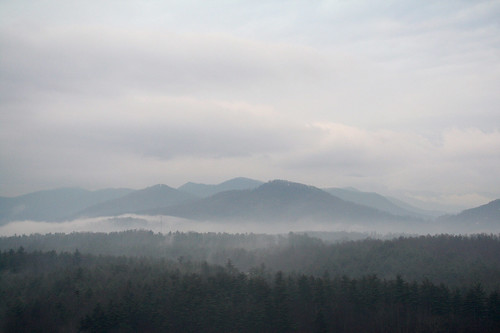
Characteristic, too, is the dreamy blue haze, like that of Indian summer intensified, that ever hovers over the mountains, unless they be swathed in cloud, or, for a few minutes, after a sharp rain-storm has cleared the atmosphere. Both the Blue Ridge and the Smoky Mountains owe their names to this tenuous mist. It softens all outlines, and lends a mirage-like effect of great distance to objects that are but a few miles off, while those farther removed grow more and more intangible until finally the sky-line blends with the sky itself.
The foreground of such a landscape, in summer, is warm, soft, dreamy, caressing, habitable; beyond it are gentle and luring solitudes; the remote ranges are inexpressibly lonesome, isolated and mysterious; but everywhere the green forest mantle bespeaks a vital present; nowhere does cold, bare granite stand as the sepulchre of an immemorial past.
-- Horace Kephart Our Southern Highlanders
And when from the snowy air
Upon the world you cast
Shadows unquiet and long
You always fall invoked, to lay a gentle hand
Upon my heart and its secret ways.
You force me to roam in thought on paths
That lead to eternity and the void, while
The felon time flees, and with him the hordes
Of cares that consume us both;
And as I look upon your peace, the soul
Of that warrior spirit within me slumbers.
-- Ugo Foscolo, from Alla sera (To Evening)
Translated by Alastair McEwen
original here
They are unique elements in a unique situation.
They are organisms with volition and a passion for self-assertion.
They move with internal freedom, and without need to conform with or to violate what is probable in the familiar world.
They have no direct association with any particular visible experience, but in them one recognizes the principle and passion of organisms.
-- Mark Rothko Possibilities no. 1 (Winter 1947-1948)
Third Movement from Feierliche Abendmusik (Holiday Music in the Evening)
A dream gives what the day wore out;
At night, when the conscious will surrenders,
Some powers, set free, reach upward,
Sensing something godly, and following.
The woods rustle, and the stream, and through the night blue sky
Of the quick soul, the summer lighting blows.
The world and my self, everything
Within and without me, grows into one.
Clouds drift through my heart,
Woods dream my dream,
House and pear tree tell me
The forgotten story of common childhood.
Streams resound and gorges cast shadows in me,
The moon, and the faint star, my close friends.
But the mild night,
That bows with its gently clouds above me,
Has my mother's face,
Kisses me, smiling, with inexhaustible love,
Shakes her head dreamily
As she used to do, and her hair
Waves through the world, and within it
The thousand stars, shuddering, turn pale.
-- Hermann Hesse
Translated by James Wright
Samuel Barber's Concerto for Violin and Orchestra, Op. 14
The opening is magical. Does any other violin concerto begin with such immediacy and with so sweet and elegant a melody? A rolled G-major chord on the piano ushers it in. The melody itself belongs to the solo violin, and it stretches its deliciously unpredictable way through twenty-four measures. If you go along with the idea that some composers are essentially vocal composers (Mozart) and some essentially instrumental (Beethoven), allowing room for the possibility that some are both (Bach), then Barber was as surely a vocal composer by nature--and here, like Mozart, he is composing vocal music for an instrument. Barber himself, I should add, thought of himself as musically "bisexual" (his adjective): "I do both." Two more themes appear, both introduced by the violin: one is lightly touched by melancholia, the other is grazioso e scherzando. The development begins with a surprising darkening of the scene. Toward the end, Barber gives us at least a hint of a cadenza . . .
-- Michael Steinberg The Concerto
To discover an order as of
A season, to discover summer and know it,
To discover winter and know it well, to find
Not to impose, not to have reasoned at all,
Out of nothing to have come on major weather,
It is possible, possible, possible. It must
Be possible. It must be that in time
The real will from its crude compoundings come,
Seeming at first, a beast disgorged, unlike,
Warmed by a desperate milk. To find the Real,
To be stripped of every fiction except one,
The fiction of an absolute—-Angel,
Be silent in your luminous cloud and hear
The luminous melody of proper sound.
-- Wallace Stevens, from Notes Toward a Supreme Fiction
more
We are solitary. We can delude ourselves about this and act as if it were not true. That is all. But how much better it is to recognize that we are alone; yes, even to begin from this realization. It will, of course, make us dizzy; for all points that our eyes used to rest on are taken away from us, there is no longer anything near us, and everything far away is infinitely far. A man taken out of his room and, almost without preparation or transition, placed on the heights of a great mountain range, would feel something like that: an unequalled insecurity, an abandonment to the nameless, would almost annihilate him. He would feel he was falling or think he was being catapulted out into space or exploded into a thousand pieces: what a colossal lie his brain would have to invent in order to catch up with and explain the situation of his senses. That is how all distances, all measures, change for the person who becomes solitary; many of these changes occur suddenly and then, as with the man on the mountaintop, unusual fantasies and strange feelings arise, which seem to grow out beyond all that is bearable. But it is necessary for us to experience that too. We must accept our reality as vastly as we possibly can; everything, even the unprecedented, must be possible within it. This is in the end the only kind of courage that is required of us: the courage to face the strangest, most unusual, most inexplicable experiences that can meet us . . . But the fear of the inexplicable has not only impoverished the reality of the individual; it has also narrowed the relationship between one human being and another, which has as it were been lifted out of the riverbed of infinite possibilities and set down in a fallow place on the bank, where nothing happens. For it is not only indolence that causes human relationships to be repeated from case to case with such unspeakable monotony and boredom; it is timidity before any new, inconceivable experience, which we don't think we can deal with. But only someone who is ready for everything, who doesn't exclude any experience, even the most incomprehensible, will live the relationship with another person as something alive and will himself sound the depths of his own being. For if we imagine this being of the individual as a larger or smaller room, it is obvious that most people come to know only one corner of their room, one spot near the window, one narrow strip on which they keep walking back and forth.
-- R.M. Rilke Letters to a Young Poet
Translated by Stephen Mitchell
I feel that the only thing that really matters in art and life is to go against the tidal wave of literalism and literal-mindedness to insist on and live the life of the imagination. A painting has to be the experience instead of pointing to it. I want to have and give access to feeling. That is the riskiest and only important way to connect art to the world -- to make it alive. The rest is just current events.
-- David Salle, quoted by Anne Bogart in A Director Prepares
We went for a walk together, the walk into the forest he would take each morning. I asked him why in the first volume of his memoirs he wrote in several distinctly different styles.
'Each style belongs to a different person.'
'To a different aspect of yourself?'
'No, rather it belongs to a different self.'
'Do these different selves coexist, or, when one is predominant, are the others absent?'
"They are present together at the same time. None can disappear. The two strongest are my violent, hot, extremist, romantic self and the other my distant, sceptical self.'
'Do they discourse together in your head?'
'No.' (He had a special way of saying No. As if he had long ago considered the question at length and after much patient investigation had arrived at the answer.)
'They watch each other,' he continued. 'The sculptor Hrdlicka has done a head of me in marble. It makes me look much younger than I am. But you can see these two predominant selves in me -- each corresponding to a side of my face. One is perhaps a little like Danton, the other a little like Voltaire.'
As we walked along the forest path, I changed sides so as to examine his face, first from the right and then from the left. Each eye was different and was confirmed in its difference by the corner of the mouth on each side of his face. The right side was tender and wild . . . I thought rather of an animal: perhaps a kind of goat, light on its feet, a chamois maybe. The left side was sceptical but harsher: it made judgments but kept them to itself, it appealed to reason with an unswerving certainty. The left side would have been inflexible had it not been compelled to live with the right. I changed sides again to check my observations.
'And have their relative strengths always been the same?' I asked.
'The sceptical self has become stronger,' he said. 'But there are other selves too.' He smiled at me and took my arm and added, as though to reassure me: 'Its hegemony is not complete!'
He said this a little breathlessly and in a slightly deeper voice than usual -- in the voice in which he spoke when moved, for example when embracing a person he loved.
-- John Berger, on Ernst Fischer The Sense of Sight
The doors of the year open,
like the doors of language,
onto the unknown.
Last night you said:
tomorrow
we must draw signs,
sketch a landscape, hatch a plot
on the unfolded page
of paper and the day.
Tomorrow we must invent,
anew,
the reality of this world.
When I opened my eyes it was late.
For a second of a second
I felt like the Aztec
on the rock-strewn peak,
watching
the cracks of horizons
for the uncertain return of time.
No, the year came back.
It filled the room,
and my glances could almost touch it.
Time, without our help,
had arranged
in the same order as yesterday,
the houses on the empty street,
the snow on the houses,
the silence on the snow.
You were beside me,
still sleeping.
The day had invented you,
but you hadn't yet accepted
your day's invention,
nor mine.
You were still in another day.
You were beside me,
and I saw you, like the snow,
asleep among the appearances.
Time, without our help,
invents houses, streets, trees,
sleeping women.
When you open your eyes
we'll walk, anew,
among the hours and their inventions,
and lingering among the appearances
we'll testify to time and its conjugations.
We'll open the doors of this day,
and go into the unknown.
-- Octavio Paz
Translated by Eliot Weinberger